
Let’s be honest… most people who launch a website hit publish, refresh their analytics, and see the number two. Themselves, twice. That’s where website traffic generation comes in: the practice of attracting visitors through organic search, paid ads, referrals, social, and email. Each channel has its own cost, timeline, and quality profile. Over at Jeff Aman, we cover the full spectrum so you can build a plan based on data, not vibes.
Definition: What Website Traffic Generation Means
Website traffic generation is the deliberate act of pulling human visitors to a URL using a mix of channels. It sounds simple. It isn’t. Because “traffic” is not one number, it’s a stack of them, and the shape of that stack tells you whether your marketing is actually working or just spinning wheels for the beginner-friendly online business crowd.
What counts as website traffic
Traffic is the total number of visitors arriving at a site inside a defined window, usually split into unique visitors and returning ones. Analytics platforms bucket the source into organic, paid, direct, referral, and social. If you’re just getting started, our beginner’s guide to passive income online walks through why those buckets matter.
Why traffic volume alone is not enough
Volume is a vanity number. What actually pays the bills is quality… measured through conversion rate, pages per visit, average session duration, and bounce rate. According to Seobility’s traffic wiki, a site’s visitor count is a direct indicator of audience relevance and is closely tied to ad revenue and sales outcomes. Which is a polite way of saying: relevance beats reach. Keep that in mind as you build your content and audience strategy.
Takeaway: if you can’t tell me what a visitor is worth, don’t chase more of them yet.
How Website Traffic Generation Works: The Core Mechanisms

Every traffic channel is really a delivery system for attention. Some are slow and compounding, some are fast and expensive, and some are so quietly powerful that people forget they exist. Here’s how the main mechanisms actually work in practice for anyone building an automated online business.
Search engine optimization (SEO)
SEO uses on-page and off-page signals to improve where your pages rank in organic search. The top three positions capture the majority of clicks for a given query, which is why ranking well matters more than ranking at all. It takes months to compound, but once it does, it keeps paying… which is exactly the model behind passive income online from scratch.
Search engine marketing (SEM) and paid ads
SEM places paid ads in search engine results pages, letting you jump the queue for competitive keywords. You pay per click, so the visits stop the moment your card gets declined. It’s fast, targeted, and unforgiving of sloppy landing pages. Pair it with a strong offer, like the funnels we break down in sales funnel examples that convert.
Referral, social, and direct traffic
Referral traffic comes through external links on other sites. Direct traffic is people typing your URL or using a bookmark, and it’s a proxy for brand recall. Social drives traffic through shares, paid social, and mentions, with quality varying wildly by platform. And email? Email is the sleeper channel… subscribers already said yes, which is why it converts so well. It’s the entire reason we push email list building for beginners so hard.
Takeaway: don’t pick one channel and marry it. Pick two, learn them, then add a third.
Types of Website Traffic and Their Quality Profiles

Not all visitors are created equal. A thousand random social clicks and a hundred organic searches for your exact product will look different in every meaningful metric. Understanding the profile of each source helps you choose the right affiliate niche and match traffic type to intent.
Organic traffic
Organic visitors arrive through unpaid search results. Its volume is directly shaped by content quality and SEO measures, and it compounds over time. It’s slow to start but cheap per visit at scale. If you’re building content that answers real questions, you’re playing the same game we outline in how to start generating passive income online today.
Paid traffic
Paid traffic is any visit generated by an ad click: Google Search Ads, display, paid social, YouTube pre-roll. It’s a spigot. Turn it on and visits arrive, turn it off and they vanish. Useful for testing offers quickly, especially if you’re validating something inside our product review roundups.
Direct and referral traffic
Direct traffic often indicates brand strength: people typing your URL directly usually convert at higher rates than cold traffic. Referral traffic from authoritative sites lifts both visits and domain authority, which then feeds back into organic. It compounds sideways, in ways worth tracking in your digital marketing dashboard.
Takeaway: combine source data with behavioral metrics. Time on page, pages per session, and goal completions are how you tell engagement from window-shopping.
How to Measure Website Traffic Generation
You cannot improve what you don’t measure, and traffic without measurement is just noise. The good news: the market-standard tools are either free or shockingly cheap for what they deliver, which keeps this accessible for the passive income beginner crowd.
Key metrics to track
The core metrics you should pin to the wall are:
- Total visits and unique visitors
- Pages per visit and average visit duration
- Bounce rate and exit rate
- Traffic by country and device
- Goal completions and conversion rate by source
Those five buckets tell you what happened, who did it, and whether it mattered. Which is basically the whole job when you’re getting started building online.
Tools used for traffic analysis
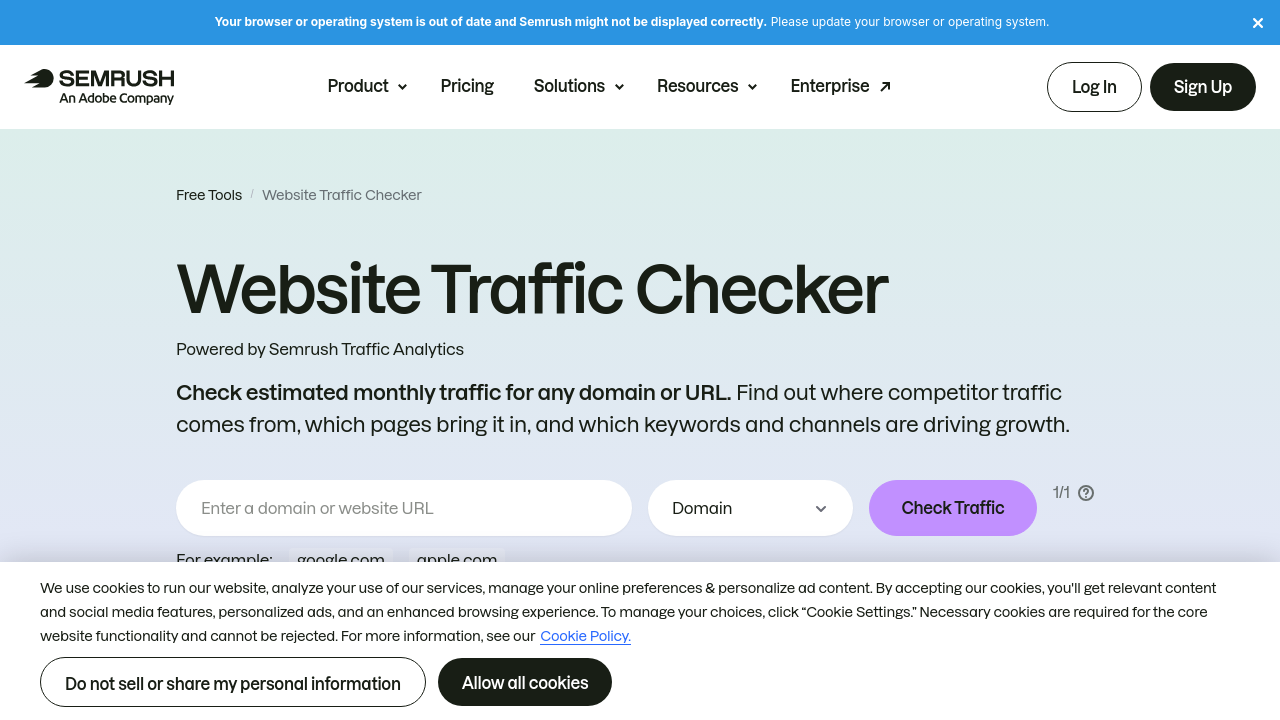
Google Analytics 4 remains the market-standard tool for traffic analysis, offering breakdowns across content, campaigns, and revenue events. Semrush’s Website Traffic Checker estimates monthly visits, splits organic vs. paid, surfaces top pages by traffic, and lists the top organic keywords for any domain. Between those two, you can validate your own campaigns and reverse-engineer competitors in the same afternoon. Then feed what you learn back into your content workflow.
Takeaway: compare month-over-month trends against your channel mix. That’s how you catch a channel losing efficiency before it drains the whole budget.
Common Misconceptions About Website Traffic Generation

Traffic generation gets treated like a magic trick… more visitors, more money, done. It doesn’t work that way, and clinging to the myths below is how people burn cash and quit. Here are the three that trip up almost every new affiliate marketer.
Misconception: More traffic always means more revenue
Reality: high volume without audience alignment produces low conversion rates. A smaller, targeted audience routinely outperforms a large, untargeted one on revenue. If your traffic doesn’t match your offer, you’re paying to fill a leaky bucket. Fix targeting first, then scale, using the approach in our first affiliate commission guide.
Misconception: Paid traffic is better than organic
Reality: paid gives speed and targeting control, then stops the second the credit card stops. Organic compounds and costs less per visit at scale. Neither is better, they solve different problems. Most durable sites run both, layered, the way we describe in automating an online business from the ground up.
Misconception: Traffic generation is a one-time task
Reality: it’s a habit. Content creation, link acquisition, technical maintenance, campaign optimization… none of them are “set and forget.” Bot traffic and simulated visits will inflate numbers without delivering real users, leading to misleading data and worse decisions. Treat traffic like ongoing email list building: steady, repeatable, and boring in the best way.
Takeaway: if it feels like a one-time sprint, you’re setting up the next quarter’s disappointment.
How to Get Started With Website Traffic Generation
Fresh site, blank analytics, no idea where to point the flashlight. Been there. Here’s the sequence that actually works for new operators, and it’s the same one we recommend inside our email marketing for affiliate beginners track.
First steps for new sites
- Do keyword research to find the exact queries your audience types.
- Build content that answers those queries directly, one page per intent.
- Nail on-page SEO fundamentals: title tags, meta descriptions, internal linking, page speed.
- Install Google Analytics 4 and Google Search Console on day one so your baseline data is clean.
- Publish consistently for at least 90 days before judging anything.
That’s the boring stuff. It’s also 80% of the win, and it’s exactly how we recommend picking a niche topic for a blog.
Choosing the right channel mix
A starter mix usually pairs SEO for long-term compounding gains with a small paid search campaign for immediate visibility during the first few months. Reviewing competitor traffic sources through tools like Semrush shows which channels and keywords already work in your niche, so you’re not guessing. Layer in email as soon as you can capture addresses, because subscribers convert far better than cold visitors, and you’ll see that repeatedly across our featured posts.
Takeaway: don’t try to master five channels in month one. Own SEO plus one paid channel, then add email.
Frequently Asked Questions
What is website traffic generation?
Website traffic generation is the practice of attracting visitors to a website through organic search, paid ads, referrals, direct visits, social platforms, and email. Each channel produces different volumes, costs, and conversion rates depending on execution and audience fit.
What are the main sources of website traffic?
The main sources are organic search, paid search and display, direct (typed URLs or bookmarks), referral (links from other sites), social media, and email. Analytics platforms record each separately so you can attribute results per channel.
What is the difference between organic and paid traffic?
Organic traffic arrives through unpaid search results and compounds over time as your content and authority grow. Paid traffic comes from ad clicks, delivers instantly, and stops the moment you pause spending. Both have a place in a balanced plan.
How do I measure website traffic generation?
Use Google Analytics 4 for on-site behavior and conversions, Google Search Console for organic visibility, and a tool like Semrush for competitive benchmarks. Track total visits, unique users, source mix, bounce rate, and goal completions monthly.
How long does it take to generate traffic to a new website?
Paid campaigns produce visits within hours. Organic search typically takes three to six months to show meaningful movement, and twelve months to compound. Consistency of publishing and technical fundamentals decide how quickly you break through.
What is traffic quality and why does it matter?
Traffic quality measures how well visitors match your offer, judged by conversion rate, session duration, and pages per visit. Low-quality traffic inflates dashboards without producing revenue, so quality metrics matter more than raw visitor counts.
What tools are used to analyze website traffic?
Google Analytics 4 is the standard for first-party behavior data. Google Search Console reports organic queries and impressions. Semrush, Ahrefs, and Similarweb estimate competitor traffic and channel splits, which helps you benchmark and find gaps.
Is it possible to generate website traffic for free?
Yes, through organic SEO, content marketing, community participation, guest posts, and organic social. Free channels demand time rather than cash, and results compound slowly. Most sustainable sites blend free organic effort with modest paid campaigns.
Conclusion
Traffic generation is not a trick, and it’s not a purchase. It’s a discipline. You research the queries, publish the content, measure the behavior, prune what fails, and double down on what works. Do that for a year and you’ll look up one day and realize the numbers stopped being the goal… they became the byproduct. If you want a friendly hand through the sequencing, come poke around Jeff Aman’s blog and start with whichever channel matches your patience level. Then get to work.