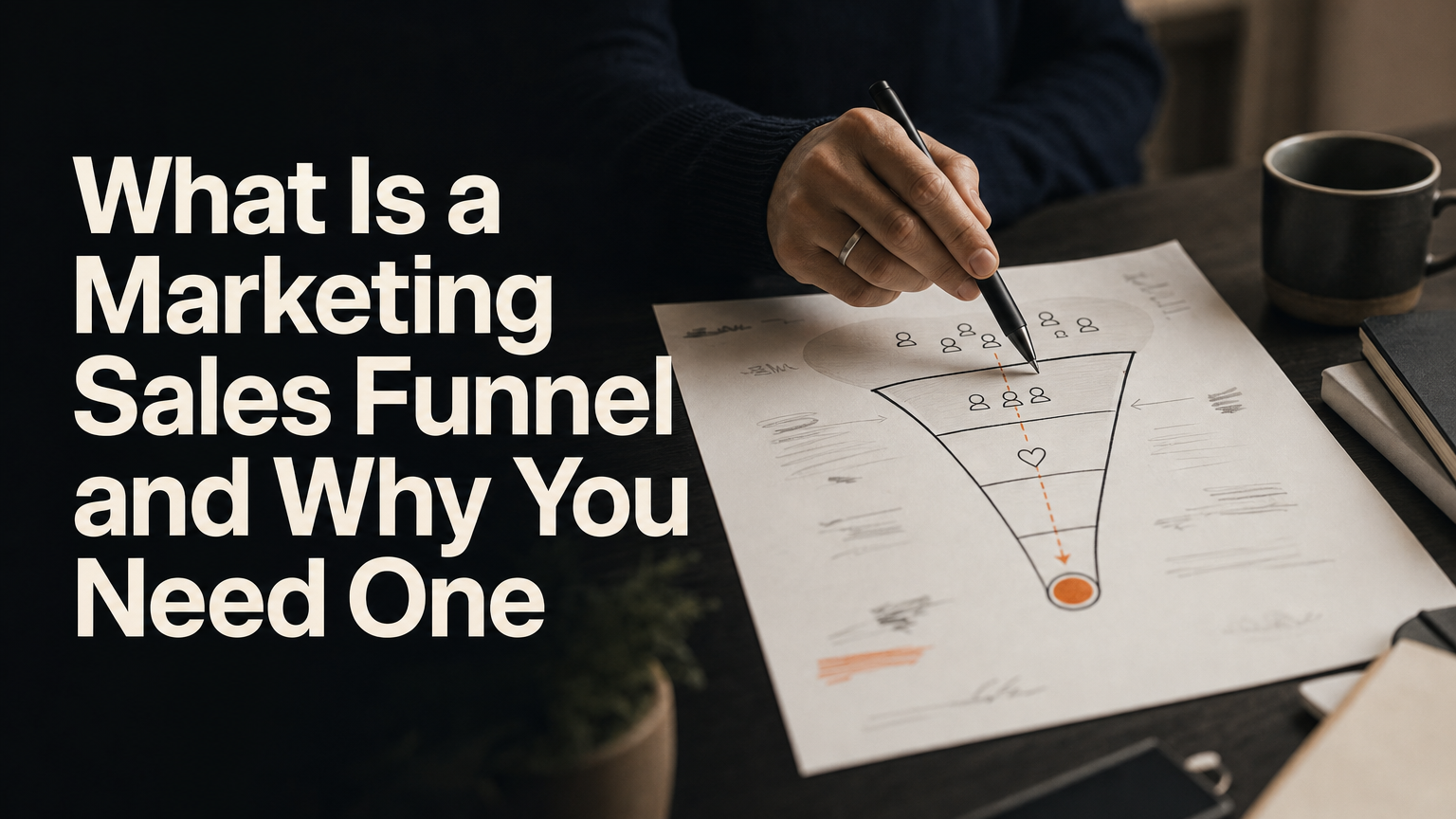
Picture this. You’ve got traffic trickling in, a handful of email subscribers, and… crickets on the sales side. Sound familiar? That’s usually a funnel problem, not a traffic problem. A marketing sales funnel is a visual roadmap of the customer journey from first hello to final purchase, and once you can see the whole map, you can fix the leaks. Over at Jeff Aman, we build funnels that turn scrollers into buyers, and this guide covers the fundamentals you actually need to know.
Definition: What Is a Marketing Sales Funnel
A marketing sales funnel is a visual model of the customer journey from first awareness of a brand to a completed purchase, mapping every touchpoint along the way. The name comes from the shape… a big pool of prospects up top, a much smaller group of paying customers at the bottom. IBM describes it as “a visual roadmap of the customer journey from initial awareness to final purchase”, which is honestly the cleanest one-line definition out there. If you’re brand new to this whole world, the beginner-friendly automation guide is a good next stop.
In plain English: it’s a map of how a stranger becomes a customer, one step at a time.
The Funnel Metaphor Explained
Imagine pouring water through a kitchen funnel. A lot goes in the top, but only what makes it through the narrow neck ends up in the jar. In marketing terms, “the water” is your audience. Some drop out at awareness, some at consideration, some at checkout. That’s normal. Understanding the shape lets you spot where you’re losing people. If you want a quick primer on why this matters for beginners, the passive income starter guide frames the same idea in dollars-and-cents terms.
Marketing Funnel vs. Sales Funnel: Key Differences
They overlap, but they’re not identical. Marketing funnels focus on awareness and lead generation, meaning content, ads, and brand-building. Sales funnels focus on converting those leads into buyers, meaning offers, follow-up, and closing. The AIDA model (Attention, Interest, Decision, Action), developed by St. Elmo Lewis all the way back in 1898, is the original framework that still underpins both. For a deeper look at the awareness end, featured posts on digital marketing are a solid rabbit hole.
The Four Core Stages of a Marketing Sales Funnel

Amazon Ads identifies four standard stages: awareness, consideration, conversion, and loyalty. Some models use three, some use seven. The number doesn’t really matter… what matters is that you know what your prospect is thinking and doing at each stage. If you’re building your first funnel, start with these four and don’t overthink it. The get started page walks through a simple starter setup.
Top of Funnel: Awareness
This is the “hi, nice to meet you” phase. Tactics include social media marketing, content creation, targeted ads, SEO, and good old word-of-mouth. Your goal isn’t to sell here. Your goal is to get noticed by the right people. If you’re an affiliate, that often means blog posts, YouTube videos, or short-form content. Choosing a niche you can actually own matters a lot at this stage, and niche examples for affiliate marketing shows what that looks like in practice.
Middle of Funnel: Consideration and Decision
Now the prospect knows you exist. They’re comparing you to alternatives, reading reviews, and asking friends. This is where personalized email nurturing, case studies, and comparison content earn their keep. Send them the right message at the right moment and you’ll pull them toward a decision without being pushy. This is exactly the terrain the affiliate email marketing guide for beginners covers.
Bottom of Funnel: Conversion and Loyalty
At conversion, prospects are ready to buy. Clear calls to action, sales pages, webinars, limited-time offers, and direct follow-up do the heavy lifting. But the funnel doesn’t end there. Research cited by OptimizePress indicates up to 72% of company revenue comes from existing customers, nearly twice the yield of new pipeline. That’s why loyalty is a stage, not an afterthought. Repeat buyers are how passive income actually compounds.
Takeaway: Map your content and offers to all four stages, not just the top.
Why Every Business Needs a Marketing Sales Funnel

Here’s the uncomfortable truth: Funnel.io reports nearly 70% of companies have never measured the effectiveness of their sales and marketing funnels. That’s a lot of businesses guessing. A structured funnel shows you exactly which stage is losing prospects so you can fix that stage instead of tearing your whole strategy apart. If you’re just starting out, this beginner walkthrough on getting passive income online from zero is a decent place to build from.
Diagnosing Where Prospects Drop Off
Without a defined funnel, small business sales become a mess of spreadsheets, sticky notes, and follow-ups that never happen. With one, you can see: “ad-to-landing-page is fine, but landing-page-to-email is bleeding out.” That’s actionable. That’s fixable. And it beats the “throw more traffic at it” reflex most people default to. The product reviews section covers tools that help with this diagnostic work.
Aligning Marketing and Sales Teams
Even if it’s a team of one (you), funnel visibility forces you to agree with yourself on what counts as a lead, what counts as a qualified lead, and when to send the sales pitch. In bigger teams, it kills the classic “marketing sends garbage leads / sales doesn’t follow up” fight. Data-driven funnel management also enables predictive insights, so you can address common objections before prospects drop out. The business automation tag collects more posts on this alignment idea.
Takeaway: No funnel = no visibility = no meaningful optimization.
Common Types of Marketing Sales Funnels

There is no single universal funnel model. OptimizePress catalogs at least 12 distinct types, each suited to different goals, audiences, and offer structures. Picking the right one saves months of wasted work. If you want concrete inspiration first, sales funnel examples that convert breaks down several real setups.
Lead Magnet and Email Funnels
The workhorse of affiliate marketing. You offer a free resource (ebook, checklist, template, mini-course) in exchange for an email address, then nurture that lead through a sequence toward a paid offer. It’s simple, cheap, and it works. If you’ve never built an email list before, start with the list-building beginner guide and you’ll be up and running fast.
Webinar Funnels
Webinar funnels use a free live or recorded presentation to educate prospects and pitch an offer at the end. They’re a strong fit for higher-ticket products and services where the buyer needs more convincing than a landing page can deliver. Warm up the audience, teach something valuable, then make the ask. For affiliates, this pairs beautifully with the tactics in how to make your first affiliate commission with email marketing.
Product Launch Funnels
Launch funnels build anticipation through a sequence of content, emails, and limited-time offers. They’re the go-to for course creators and software releases. Think three or four pieces of pre-launch content, an open cart window, and a hard close. High effort, high reward. The author archive has more on running these as a solo operator.
Takeaway: Match the funnel type to your offer complexity and price point, not to whatever’s trending on Twitter.
How to Build and Optimize Your Marketing Sales Funnel
Building an effective funnel starts with defining your target audience and mapping the specific questions and objections at each stage of their journey. Not generic personas… actual questions like “does this integrate with X?” or “is this beginner-friendly?” That research shapes every headline, email, and offer downstream. The featured posts hub is a decent library to steal ideas from.
Mapping the Funnel to Your Customer Journey
At the top, content marketing, SEO, paid ads, and social drive awareness. In the middle, retargeting, case studies, and comparison pages build confidence. At the bottom, sales pages, testimonials, and follow-up emails close the deal. Automation tools handle the “right message at the right moment” part, from welcome sequences to cart abandonment. If you want authority to compound while you sleep, building authority through email marketing is the play.
Measuring and Improving Funnel Performance
Track four metrics at minimum: traffic by stage, opt-in rate, lead-to-customer conversion rate, and customer lifetime value. Each one tells you a different story about funnel health. IBM notes that modern funnel optimization increasingly uses AI and machine learning to predict behavior, personalize content, and surface the highest-value leads for follow-up. You don’t need enterprise tools to start… you just need to actually look at your numbers. The blog archive has walkthroughs on the specific tools worth using.
Takeaway: Build lean, measure honestly, iterate weekly.
Common Misconceptions About Marketing Sales Funnels
Funnels get a lot of hate online. Most of it is based on misunderstandings. Let’s clear a few up. Beginners especially get tangled in these, and the beginner guide tag is where I’ve stashed the antidotes.
Misconception: The Funnel Is Linear / Reality: The Journey Is Non-Linear
Amazon Ads notes that prospects enter, exit, and re-enter the funnel across multiple platforms and devices. Someone might see your Instagram post today, forget about you for six weeks, then Google your review and buy. The funnel is a model, not a literal one-way tube. Design for real behavior. The list-building tag has more on capturing people whenever they show up.
Misconception: Funnels Are Only for Large Businesses / Reality: Any Business Can Benefit
You do not need an enterprise budget. A two-step funnel (ad or blog post → landing page → email sequence) can meaningfully lift conversion rates for a solo affiliate. The small-business friendly starter guide shows how to do this on a shoestring.
Misconception: The Funnel Ends at Purchase / Reality: Loyalty Is a Funnel Stage
Treating the funnel as complete after checkout leaves the highest-ROI segment on the table. Existing customers are cheaper to sell to and more likely to refer new ones. Funnel.io experts also point out that the “funnels are dead” argument misidentifies the problem, since static funnels underperform, but adaptive ones still work fine. Ongoing testing of headlines, offers, and sequences is the price of admission. The affiliate marketing tag has more on the retention side.
Frequently Asked Questions
What is the difference between a marketing funnel and a sales funnel?
Marketing funnels focus on brand awareness and lead generation at the top and middle. Sales funnels focus on converting those leads into buyers at the bottom. They overlap, work together, and share the same underlying customer journey.
What are the stages of a marketing sales funnel?
The four standard stages are awareness, consideration, conversion, and loyalty. Some models add discovery, evaluation, or advocacy for more granularity. The exact number matters less than covering awareness at the top and retention at the bottom.
How do I build a marketing sales funnel from scratch?
Start by defining your audience and their key questions at each stage. Create a lead magnet, a landing page, an email sequence, and one clear offer. Then measure opt-in and conversion rates and iterate weekly.
What is a good conversion rate for a sales funnel?
Benchmarks vary by industry and offer price. Landing page opt-ins commonly range from 20 to 40 percent, and lead-to-customer conversion often falls between 2 and 5 percent. Track your own trend line rather than chasing industry averages.
Do I need a marketing sales funnel if I have a small business?
Yes. Even a simple two-step funnel outperforms scattered ads and random social posts. Small businesses often see the biggest lift because they’re starting from an unoptimized baseline, and a basic funnel plugs the most obvious leaks fast.
What tools do I need to create a sales funnel?
At minimum you need a landing page builder, an email service provider, and a payment processor. Optional adds include analytics, a CRM, and marketing automation software. Start simple, and only add tools when a specific problem justifies the cost.
How do I know if my sales funnel is working?
Track traffic by stage, opt-in rate, lead-to-customer conversion, and customer lifetime value. If those numbers trend up month over month, the funnel is working. If any stage flatlines or drops, that’s the leak to fix next.
What is the AIDA model and how does it relate to a sales funnel?
AIDA stands for Attention, Interest, Decision, Action. Developed by St. Elmo Lewis in 1898, it’s the original funnel framework and still maps neatly onto modern stages: awareness, consideration, conversion, and the follow-through that turns customers into repeat buyers.
Wrapping It Up
Funnels aren’t a magic trick… they’re a map. Once you can see where prospects come in, where they get stuck, and where they leave, you can fix things one leak at a time instead of throwing money at the top and hoping. Start small, measure honestly, and iterate. If you want a hand building a funnel that actually converts (without the guru fluff), the Jeff Aman resource library is where I keep the playbooks. Now go build the thing.