
An affiliate commission is the reward a business pays a partner for driving a sale, lead or other agreed action through the partner’s tracked link. It’s usually a percentage of the sale or a fixed amount per action. Sounds simple… and it is, once you see one move from click to payout. At Jeff Aman, the whole game is helping beginners earn that first one. Here’s the full picture, with real numbers.
Affiliate Commission Meaning: The Definition
An affiliate commission is a performance-based reward a business offers external partners for generating sales, leads or conversions through their marketing, as the growann affiliate commission glossary puts it. It’s typically a percentage of the sale, though it can also be a fixed amount per transaction or action. Either way, it only gets paid when the agreed result happens.
In plain language: you send someone to a product, they buy, and the company pays you a cut.
That’s it. No result, no cut. Keep that in your head and the rest of this article clicks into place.
How Affiliate Commission Works, Step by Step
Coursera describes four main actors in affiliate marketing: the affiliate, the merchant, the affiliate network and the customer. You’re the affiliate. Everyone else has a job too.
The click-to-payout flow
- Sign up for a merchant’s affiliate program, directly or through a network.
- Get your tracked link. This unique link tells the merchant the buyer came from you.
- Share it with your audience: email, a blog post, a video, social media.
- A buyer clicks and purchases (or signs up, or starts a trial, depending on the program).
- Tracking credits the sale to your account. Clear agreements and reliable tracking are what make this trustworthy.
- You get paid on the program’s payout terms.
Miss step 2 and you’re basically doing free advertising for someone else. Always use the tracked link.
Worked example: percentage vs fixed amount
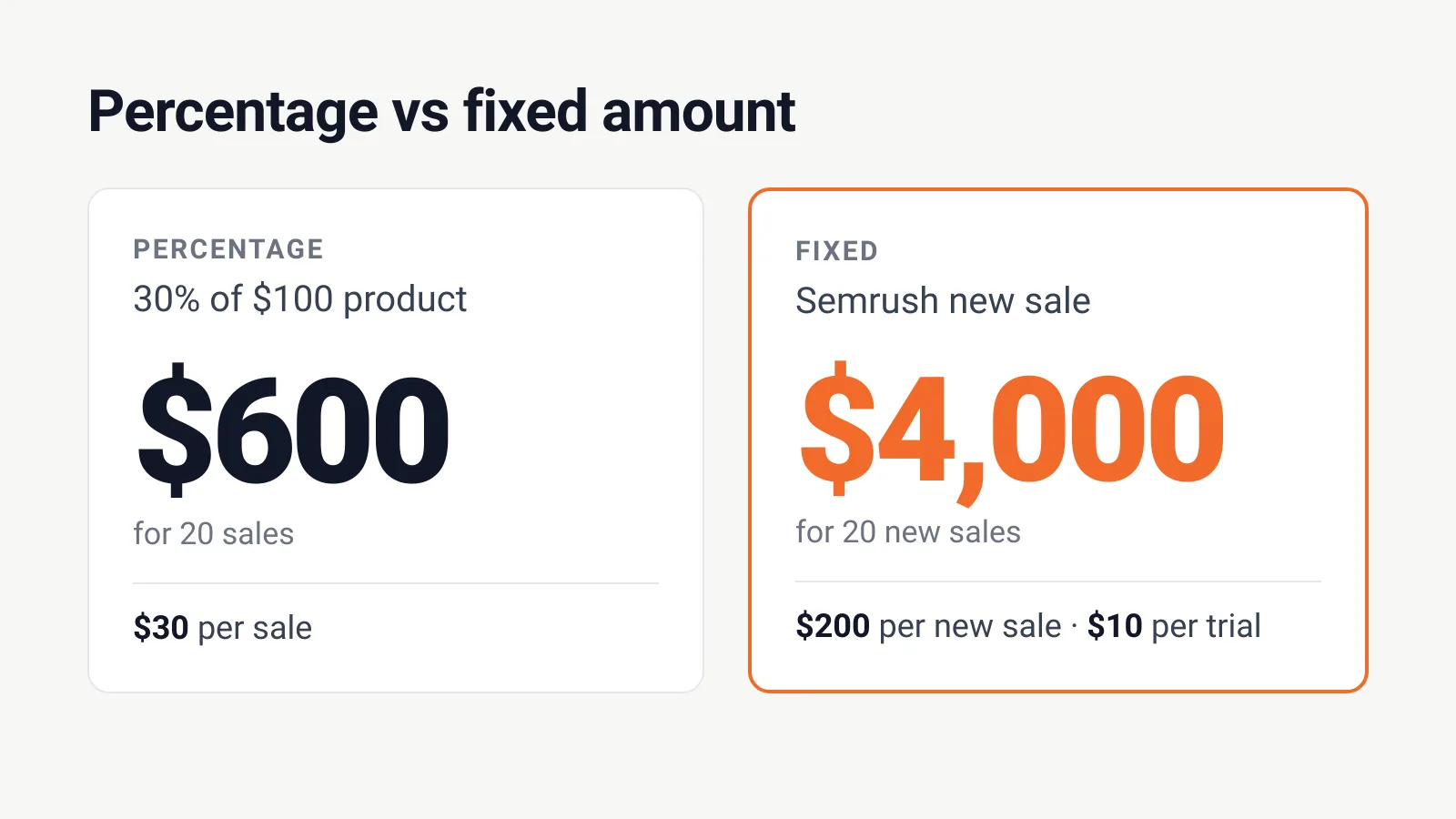
For example, say you promote a $100 product with a 30% commission. Each sale earns you $30. Make 20 sales in a month and that’s $600.
Now the fixed-amount version. According to impact.com, Semrush restructured its program to pay partners $10 per trial activation and $200 per new sale. Same 20 new sales there? That works out to $4,000, before any trial payouts.
| Model | Per action | 20 actions |
|---|---|---|
| Percentage (30% of $100) | $30 | $600 |
| Fixed (Semrush new sale) | $200 | $4,000 |
| Fixed (Semrush trial) | $10 | $200 |
Takeaway: the headline percentage means nothing until you multiply it by the price.
Common commission models: CPA and revenue share
IREV splits commissions into two main buckets:
- CPA (cost per action): a fixed amount or percentage for a defined action, like a sale or a signup. Usually a one-time payment.
- RevShare (revenue share): a percentage of the revenue a customer brings in, which can continue across that buyer’s lifetime.
Recurring beats one-time when the product bills monthly. Check which model a program uses before you promote it.
Why Affiliate Commission Matters

Commissions line up everyone’s interests. Nobody gets paid for doing nothing.
For businesses
A merchant only pays when results show up. Amazon Associates, which Coursera calls one of the largest affiliate programs in the world, pays affiliates up to 10 percent on qualifying referrals. That’s a sales force paid purely on output.
For beginners
You don’t need inventory, a warehouse or a customer service desk. You need traffic, a link and trust. Semrush’s $200 per new sale shows how much a single referral can be worth in the right program. If you’re weighing where to start, see the best affiliate marketing platforms for beginners.
For list builders like ECF users
Here’s where it gets interesting. Commissions are one-off events… but an email list keeps paying attention. ECF 2.0 packages seven passive income opportunities into one funnel, so a single lead can trigger commissions across multiple programs. And it’s free to register.
Takeaway: chase leads, not just clicks. If list building is new to you, read how to build an email list for affiliate marketing.
Common Misconceptions About Affiliate Commissions

Misconception: A commission is a paycheck
Reality: IREV is blunt about it. Commissions aren’t regular wages; they’re paid when you meet targets. Some months are great. Some months are quiet. Plan for that.
Misconception: Every program pays the same
Reality: rates vary a lot by vertical and product type, and IREV says commissions commonly fall between 5 and 30%. Rates vary by vertical and product type, so check each program’s terms.
Misconception: You need a product of your own
Reality: affiliate marketing is promoting someone else’s product or service and earning a commission on the resulting sales. The product, checkout and support are the merchant’s problem. Your job is the promotion.
Misconception: Beginners can’t start
Reality: prebuilt systems exist precisely for beginners. Jeff Aman states he has generated multiple six figures in affiliate commissions year after year and reached #1 on the leaderboard across multiple platforms. The point isn’t the trophy… it’s that a repeatable system can be taught. For an honest look at difficulty, read whether affiliate marketing is hard for beginners.
Related Concepts
Affiliate marketing
A performance-based model where a business rewards affiliates for visitors or customers they bring in through their own marketing.
Affiliate link
A unique tracking link that lets the merchant see where a sale or lead came from and credit the right affiliate.
Commission rate
The amount a partner receives for every conversion they drive, often a percentage. Our guide on the typical affiliate commission rate breaks down what’s normal.
CPA
Cost per action: a fixed amount or percentage paid for a specific action defined by the merchant.
Revenue share
A percentage of the revenue a referred customer generates, potentially for their entire lifetime as a customer.
Sales funnel
The path a visitor takes from first click to purchase. Here’s what a sales funnel is and how it works, plus a guide to building an affiliate marketing sales funnel from scratch.
How to Get Started Today
Knowing the meaning is nice. Earning one is better. Four moves:
- Pick one product you’d honestly use. Trust sells. Hype doesn’t.
- Read the commission terms. Percentage or fixed? One-time or recurring? Do the math like the example above.
- Get your tracked link and use it everywhere you share.
- Start building an email list. A list is traffic you control. Learn how to write an affiliate marketing email template that sells.
Prefer a shortcut? ECF is a free, prebuilt system: register, get a unique link, and send people to it. It includes a done-for-you page, expert video content and automated follow-ups, plus LeadsLeap integration for lead management and SendShark for broadcast emails. Jeff Aman left his full-time job within about a year of focusing on daily list building, which says a lot about where the use… er, the payoff, lives.
For the full roadmap, read how to start affiliate marketing as a beginner, or the plan for starting an affiliate marketing business from scratch. Then pick your one product today.
FAQ: Frequently Asked Questions
How much do affiliates get paid?
It depends on the program. Commissions are a percentage of the sale or a fixed amount per action.
What’s a good affiliate commission?
A good commission is one that pays well per sale once multiplied by the product price. Rates commonly run 5 to 30%, varying by vertical and product type. Recurring revenue share can beat a higher one-time rate.
Can a beginner do affiliate marketing?
Yes. You promote someone else’s product, so no inventory or product creation is needed. Beginners mainly need a tracked link, an audience and patience. A prebuilt funnel can reduce the setup work for newcomers.
Do affiliates really make money?
Yes, though results vary widely. Commissions are paid only when targets are met, so income depends on traffic, trust and offer choice. Amazon Associates alone has tens of thousands of affiliates earning commissions.
Is an affiliate commission the same as a salary?
No. A salary arrives on schedule regardless of results. A commission is paid only when you drive the agreed sale, lead or action, so monthly earnings can rise and fall noticeably.
What is the difference between CPA and revenue share?
CPA pays a fixed amount or percentage for a defined action, usually once. Revenue share pays a percentage of a customer’s revenue, and it can continue for as long as that customer keeps paying.
How are commissions tracked?
Through your unique affiliate link. When someone clicks it and completes the agreed action, the merchant’s tracking system records the source and credits your account, which is why always using the tracked link matters.
Does it cost money to start?
Joining most affiliate programs is typically free, though traffic and tools can cost money. The Easy Commission Funnel is free to register, which lets beginners begin without upfront spending on a funnel.
Conclusion
An affiliate commission is simple at heart: you send a buyer through a tracked link, they take the agreed action, and you get a cut, either a percentage or a fixed amount. Do the math on every offer, favor recurring where you can, and build a list so you’re not starting from zero every month. If you want a prebuilt path from link to lead to commission, see how the Easy Commission Funnel works, built by its founder, Jeff Aman. Then go get that first one.