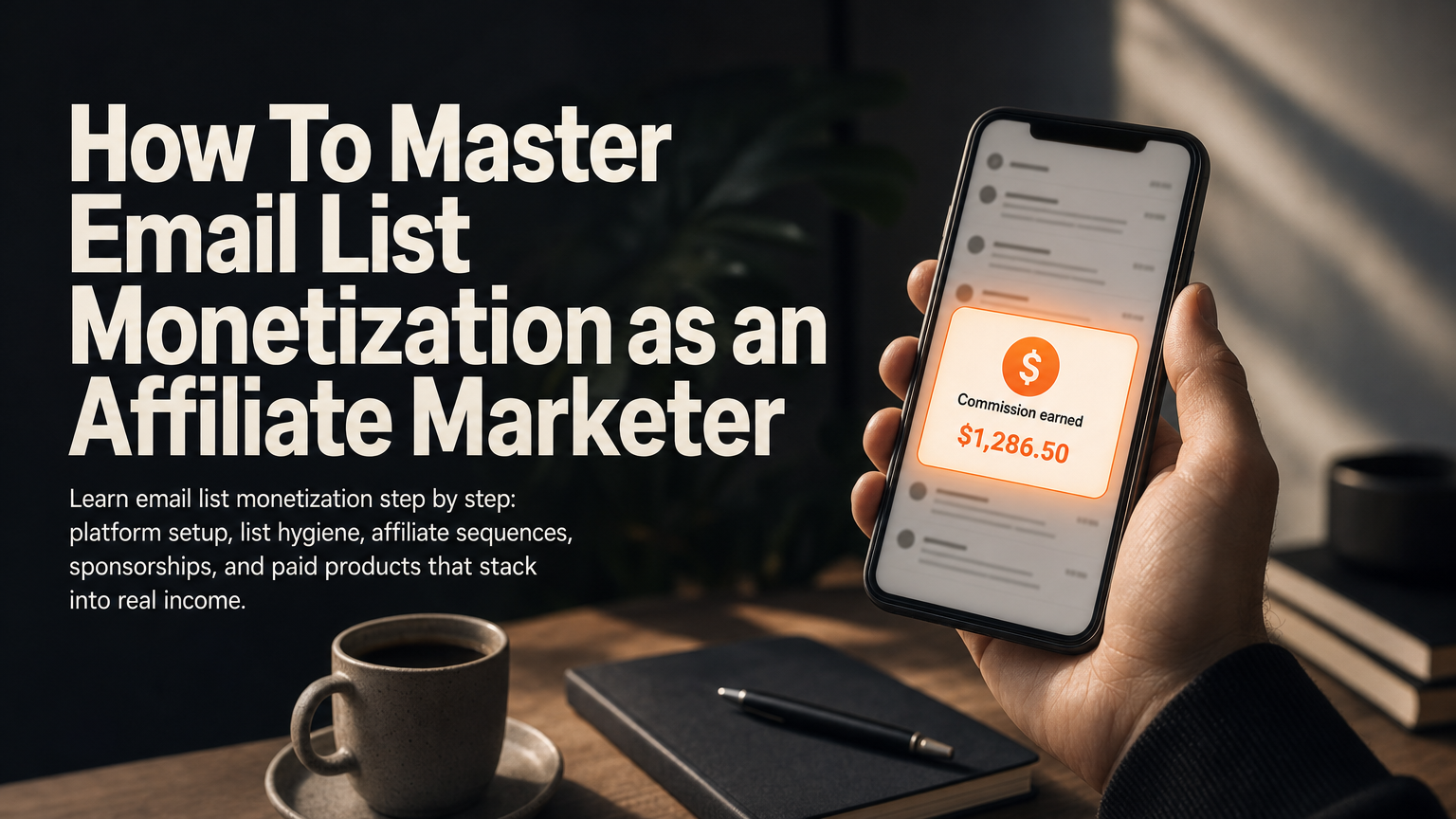
Here’s the promise: your email list can pay you every single week, even if you never build a product of your own. That’s the beauty of affiliate marketing on a subscriber base you own. I learned this the hard way, tanking my first “big” promo email back when I thought “spray and pray” was a strategy. Fast-forward a bit, and Jeff Aman has spent years documenting frameworks that actually turn inbox real estate into real commissions. This guide walks you through the whole thing… start to finish.
What You Will Need Before You Start

Before you touch a single affiliate link, you need three things sorted: the right software, a list big enough to move the needle, and squeaky-clean subscriber data. Skip any of these and you’ll be frustrated within a month. Ask me how I know. Let’s break each one down before you start monetizing your email list with any real intent.
The right email platform
Your ESP is the foundation. If it can’t tag subscribers, segment by behavior, and fire off automations, you’re basically renting a megaphone instead of running a business. Look for tagging, conditional automations, and native affiliate-friendly policies (some platforms ban affiliate links outright, which is a nasty surprise mid-launch). Getting this right upfront saves rebuilds later, and it makes serious affiliate marketing workflows possible from day one.
A minimum viable list size
According to emailtooltester.com, roughly 5-10% of free subscribers convert to paid tiers on most models. That math means your list size directly caps your revenue. You don’t need 100,000 subscribers, but you do need enough engaged readers to make offers worth sending. Most affiliate marketers start seeing meaningful commissions somewhere between 500 and 2,000 active subscribers, so keep your list building engine running constantly.
Compliant subscriber data
GDPR and CAN-SPAM are not optional. Explicit opt-in consent, a working unsubscribe link, and a physical address in the footer… these are baseline. Selling or renting your list without consent can trigger legal penalties and get your ESP account nuked. Also: affiliate networks like Amazon Associates and ShareASale often ask for proof of audience during approval, so document your niche and count before you apply. It speeds up lead generation partnerships enormously.
Takeaway: platform, size, compliance. Nail all three or the rest of this guide won’t stick.
Before You Start Monetizing

Here’s the mistake I made early on: I started slapping affiliate links into emails without knowing what my baseline looked like. So when performance dipped, I had no idea if it was the offer, the audience, or me. Don’t do that. Audit first, benchmark second, then monetize. It’s less exciting but the numbers thank you later, and your conversion optimization work becomes measurable instead of guesswork.
Audit your list health
Send a re-engagement campaign before your first big monetization push. Subject line: “Still want to hear from me?” Something like that. Anyone who doesn’t open in two weeks, prune them. Cold subscribers drag down open rates, which drags down inbox placement, which drags down affiliate clicks. According to Upland Software, email marketing ROI can reach $38 for every $1 spent, but only if your list is actually engaged. A bloated list is a broken list, so build list hygiene into your monthly routine.
Set revenue goals and track baselines
Write down these numbers today: open rate, click-to-open rate, unsubscribe rate, list growth rate. Then set a revenue goal per subscriber per month. Even something rough like “$0.50 per subscriber per month” gives you a target. Segment subscribers by interest or past clicks before dropping affiliate links; relevance lifts click-through significantly, and it’s the cheapest lever inside any sales funnel you’ll build.
Takeaway: clean the list, measure the baseline, then start selling. Not before.
Step-by-Step Affiliate Monetization Methods

Now we get to the fun part… actually making money. There are four core plays here, and you should run them in this order. Each one compounds on the last, and by the end you’ll have a system that earns while you sleep. This is the heart of the digital marketing stack for creators.
Step 1: Add affiliate links to broadcast emails
Action: pick one product you already use and love. Write a broadcast email with one affiliate recommendation, placed in the first two paragraphs. Outcome: subscribers click on the offer before they get bored. Verification: check your ESP for click rate on the link… you should see it beat your average CTR within 48 hours. One clear CTA per email, always. This is where beginner-friendly affiliate income starts to click.
Step 2: Build automated affiliate sequences
Action: set up a welcome sequence of 5-7 emails inside your ESP. Outcome: every new subscriber receives evergreen affiliate recommendations without you touching anything after setup. Verification: enroll a test email and confirm each message fires on schedule. This is passive income in the truest sense, and it compounds monthly. See how passive income actually stacks up when automations do the selling.
Step 3: Write dedicated promotional emails
Action: once per week, send a single dedicated email focused entirely on one product. Options: product review, comparison (“X vs Y”), or limited-time offer. Outcome: purchase intent is primed, and conversion rates usually beat incidental link placements by a wide margin. Verification: check revenue attribution in your affiliate dashboard within 72 hours. For pacing tips, Jeff’s rundown on making your first affiliate commission breaks the tempo down step by step.
Step 4: Add newsletter sponsorships
Action: once your list crosses ~2,000 engaged subscribers, list yourself on sponsorship marketplaces. Outcome: brands pay a flat fee for placement inside your newsletter, complementing commissions. Verification: track sponsor fill rate and repeat bookings. Keep sponsored content minimal and relevant, because as Upland Software notes, subscribers joined to hear from you, not a parade of third-party brands. Building authority in your niche is what makes sponsors actually want in.
Takeaway: broadcast, automate, dedicate, sponsor. Layer them in that order.
Additional Monetization Channels Beyond Affiliate Links

Affiliate commissions are great, but they’re not the whole game. The most stable creator businesses stack three or four income streams so a single program pause doesn’t wipe out the month. Here’s where to expand once your affiliate foundation is humming, and where online business fundamentals start paying real dividends.
Paid newsletters and premium content
Paid subscriptions via platforms like Substack or ConvertKit give you recurring, predictable revenue. According to emailtooltester.com, the Flow State newsletter charges $5/month and has hundreds of paying subscribers. Do that math and it’s a full-time income from a tiny slice of a list. Pair it with your free content strategy so free readers naturally graduate into paid ones.
Digital products and online courses
Ebooks, templates, mini-courses… anything you create once and sell forever. Digital products carry roughly 100% margin after creation costs, which makes them a killer complement to affiliate commissions. Promote them exclusively to subscribers for the first week to reward loyalty. Build a small catalog of digital products and your revenue per subscriber can quickly double.
Paid community memberships
Bundle your newsletter with a private community, coaching calls, or a forum, and you’ve built a membership. The Mind the Product Membership model shows how this works: newsletter + community + Q&A sessions in one paid tier. According to Statista, global email marketing revenue was $7.5 billion in 2020 and is projected to hit $18 billion by 2027, so the demand for email-based products isn’t going anywhere. Diversifying across streams reduces volatility, which is the whole game plan behind smart business automation.
Takeaway: affiliate + one recurring stream = a real business. Don’t stop at commissions.
Troubleshooting Common Email Monetization Problems
Something will break. It always does. Here are the five failure modes I’ve seen most often, and the fixes that actually work. Bookmark this section, and revisit it any time your marketing funnels start behaving weirdly.
Low click-through rates on affiliate links
- Symptom: affiliate links get few clicks.
- Cause: offer-audience mismatch or the link is buried below the fold.
- Fix: segment by interest and place the primary link within the first two paragraphs.
High unsubscribe rates after promotional emails
- Symptom: unsubscribe spike after a promo send.
- Cause: frequency or relevance disconnect.
- Fix: cap dedicated promos at once per week and A/B test subject lines to set expectations. Watch your baseline conversion metrics to spot the drift early.
Affiliate application rejections
- Symptom: the network says no.
- Cause: insufficient audience or an incomplete profile.
- Fix: screenshot list size and engagement stats, add a clear niche description, reapply.
Emails landing in spam during campaigns
- Symptom: deliverability tanks mid-launch.
- Cause: a sudden spike in sending or spammy link patterns.
- Fix: warm up volume gradually and route affiliate links through a custom tracking domain so your root domain stays clean. This protects your web traffic sources across the board.
Inconsistent monthly revenue
- Symptom: wild income swings month to month.
- Cause: over-reliance on one affiliate program.
- Fix: run two or three complementary programs so a single pause doesn’t zero you out.
Takeaway: diagnose, don’t guess. Every symptom has a specific fix.
Frequently Asked Questions
How many subscribers do I need before monetizing my email list?
You can start with as few as 500 engaged subscribers if the niche is tight. Most affiliate marketers see meaningful commissions between 1,000 and 2,000 active readers, though engagement matters more than raw count.
What is the average revenue per subscriber for affiliate email marketers?
Industry benchmarks land between $0.50 and $2 per subscriber per month, depending on niche, offer quality, and send frequency. Finance and software niches typically outperform lifestyle niches by a wide margin due to higher commissions.
Can I monetize a small email list with affiliate marketing?
Yes. A tight, engaged list of 500 subscribers in a specific niche can outperform a bloated list of 50,000 disengaged readers. Focus on relevance, segmentation, and one clear call to action per email.
How often should I send promotional affiliate emails to my list?
Cap dedicated promotional emails at once per week. Weave contextual affiliate links into regular newsletters more often, but a hard sell every seven days is usually the ceiling before unsubscribe rates start climbing.
Do I need to disclose affiliate links in my emails?
Yes. The FTC requires clear affiliate disclosures in the United States, and similar rules apply across Europe. A short line at the top of the email like “This email contains affiliate links” is enough to stay compliant.
What affiliate programs work best for email marketers?
Recurring-commission SaaS programs, digital course platforms, and niche-specific software tend to convert best over email because the audience is already opted-in for expert recommendations. Amazon Associates works too, though commission rates are low.
How do I avoid spam filters when including affiliate links in emails?
Use a custom tracking domain instead of raw affiliate URLs, warm up sending volume gradually, keep image-to-text ratios balanced, and authenticate your domain with SPF, DKIM, and DMARC records before running any big promo.
What is the difference between email monetization and email marketing?
Email marketing builds the relationship and brand awareness. Email monetization is the subset of that activity focused specifically on generating revenue from the list, whether through affiliate commissions, sponsorships, paid subscriptions, or product sales.
Wrapping Up
Email list monetization isn’t magic; it’s a stack of small, boring decisions made in the right order. Get the platform right, clean the list, layer in broadcasts, then automations, then dedicated promos, then sponsorships. Add a digital product or paid tier when you’re ready. Diversify so no single program controls your income. That’s it. For deeper frameworks and templates built for affiliate marketers, Jeff Aman’s blog is where the next steps live. Now go send that email.