Let me guess… you googled “b2b sales funnels” because someone on your team keeps saying “MQL” and “SQL” like they’re different things, and you’re nodding along in meetings hoping nobody quizzes you. Been there. A B2B sales funnel is a stage-by-stage model that maps how business buyers move from first discovering a solution to signing a contract, accounting for long sales cycles and multiple decision-makers along the way. Understanding this framework helps sales and marketing teams agree on lead definitions, spot where prospects drop off, and deliver the right content at the right moment. Jeff Aman breaks down the core concepts, stages, and build steps below.
Definition: What Is a B2B Sales Funnel
Here’s the plain-English version. Before I ever built anything resembling a funnel, I thought “sales funnel” was just marketer-speak for “website.” It’s not. It’s a model… a way of picturing how strangers become buyers, one stage at a time. And in B2B, that journey has a lot more moving parts than a Netflix signup.
The Plain-English Explanation
According to Gong, a B2B sales funnel is a stage-by-stage model that depicts how prospects move through the buying process, from initial awareness all the way through to purchase. The important bit? It’s a representation of the buyer’s journey, not a mandatory checklist. Buyers can skip stages, revisit them, or double back after a demo goes sideways. If you want a broader primer on where funnels sit inside the wider digital marketing playbook, start there and come back.
B2B Sales Funnel vs. Sales Pipeline
People throw these around like synonyms. They’re not. A sales funnel reflects the buyer’s journey in broad strokes; a sales pipeline is your internal sales process, with mandatory stages a rep has to complete (discovery, demo, proposal, close). Historically the AIDA model, Awareness/Interest/Desire/Action from 1898, is the granddaddy of modern sales funnels. It’s fine for a lemonade stand. It’s too simple for a modern B2B environment with buying committees and 12-touch nurtures.
Takeaway: if your team argues about funnel stages, they’re actually arguing about the pipeline. Different tool, different conversation.
How B2B Sales Funnels Differ From B2C Funnels
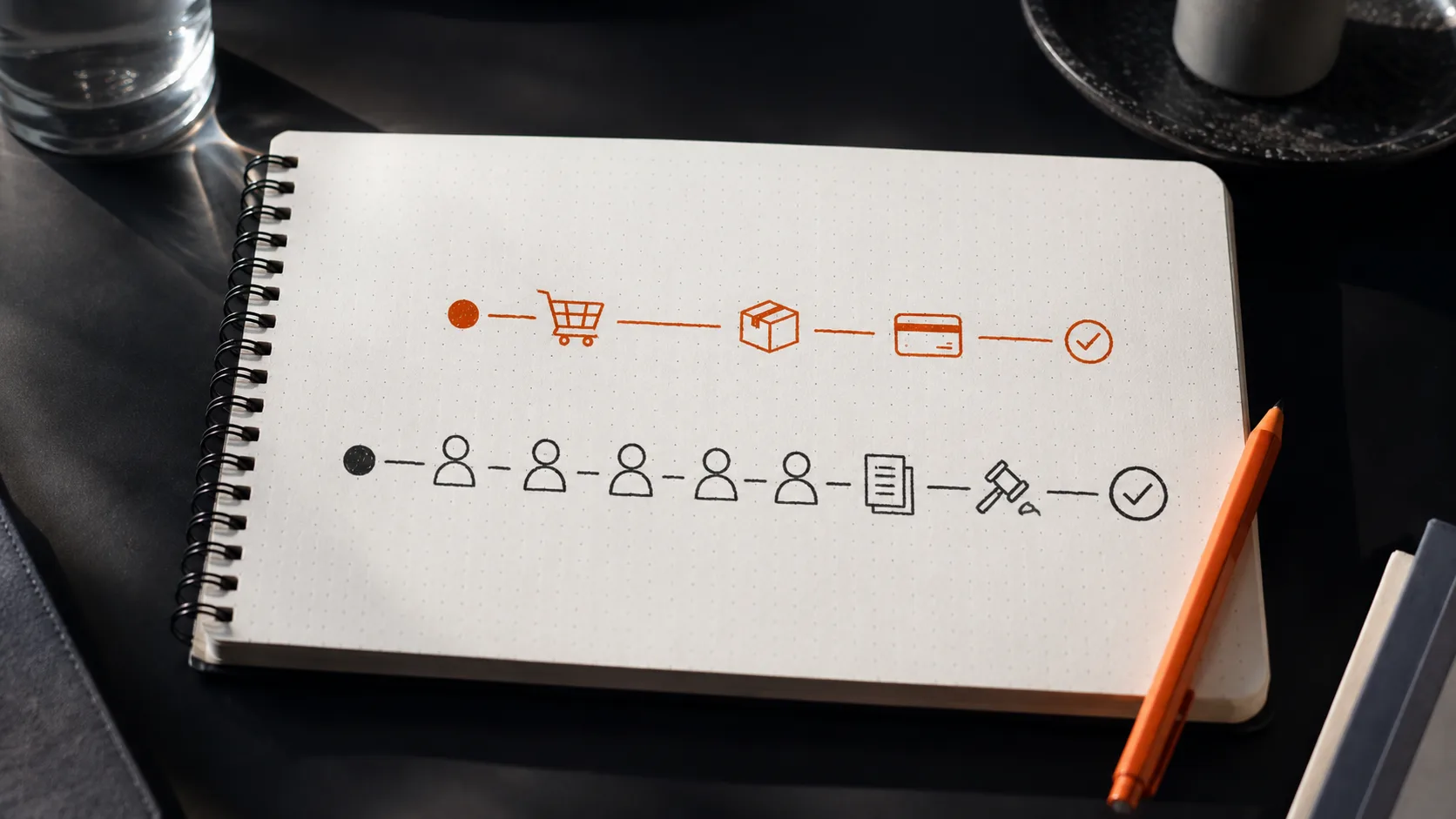
If you’ve only ever run consumer campaigns, the B2B shift feels weird at first. Slower. More paperwork. More people in the room. Here’s why the funnel has to bend.
Sales Cycle Length and Decision-Makers
B2C buys close in minutes to weeks. Someone sees a TikTok, taps the link, buys the moisturizer. Done. B2B is months to years. Salesforce reports that B2B buying committees typically include 6 to 10 people, each dragging their own priorities into the room. That’s why generic “buy now” tactics fall flat and why smart lead generation has to plan for multiple stakeholders, not one buyer.
Content Depth and Purchase Drivers
Here’s the stat that reframed everything for me. According to Gartner, B2B buyers spend only 17% of their buying journey meeting with potential suppliers. Seventeen. Percent. Which means most of your selling happens before a sales rep ever gets a Zoom link. That puts enormous weight on your content strategy: technical white papers, ROI case studies, comparison guides. B2B purchases are driven by logic, efficiency, and ROI. B2C is emotion and immediate need. Different fuel, different engines.
Takeaway: if your content looks like a lifestyle ad, you’re not selling to a B2B buyer. You’re entertaining them.
The Core Stages of a B2B Sales Funnel

Most teams break the funnel into three big buckets: TOFU, MOFU, BOFU. Top, middle, bottom. Some add a retention layer at the end. Let’s walk through each.
Top of Funnel (TOFU): Awareness
The buyer knows they have a pain point… not that you exist. Your job is to educate. That means SEO-driven blog posts targeting early-stage searches (“how to reduce factory downtime”), educational social content, and industry reports. Think helpful, not salesy. Solid blogging is still one of the cheapest ways to earn awareness that compounds.
Middle of Funnel (MOFU): Consideration and Interest
Now the buyer is researching solutions and comparing vendors. This is where trust wins. Webinars, how-to guides, detailed case studies, comparison content. Building an email list at this stage is gold, because MOFU shoppers rarely buy on their first visit. A patient email-list-building motion keeps you in front of them while they compare.
Bottom of Funnel (BOFU): Evaluation and Conversion
The buyer needs proof. Demos, pricing pages, ROI calculators, stakeholder buy-in decks, security docs. Anything that lets the champion inside the company sell your solution up the chain. Many B2B teams extend the funnel beyond conversion into retention and expansion, because a signed contract is the start of customer lifetime value, not the end. Salesforce reports 83% of marketers now say they have a clear view of their impact on the sales pipeline, which is why conversion optimization has become a shared responsibility.
Takeaway: each stage needs its own content and its own success metric. Don’t send a demo request form to someone who just wanted to read a blog post.
Why a Structured B2B Sales Funnel Matters

I used to think funnels were an overengineered spreadsheet fetish. Then I watched a company lose a six-figure deal because marketing called someone an MQL and sales called them a tire-kicker. Nobody agreed on what “qualified” meant. Structure fixes that.
Alignment Between Sales and Marketing
A defined funnel forces agreement on the boring but critical stuff: what’s an MQL, what’s an SQL, when does a lead get handed over. Without shared definitions you get finger-pointing and fragmented data. Even a lightweight framework, backed by a bit of business automation, keeps both teams working from the same scoreboard.
Identifying and Fixing Bottlenecks
Once stages are defined, you can see where prospects drop off. Losing 80% between demo and proposal? That’s a pricing or fit problem. Losing them at MOFU? Your nurture emails are weak. FullFunnel.io documented shaving 20 days off their average sales cycle after refining their funnel process, which is the kind of margin most teams leave on the table. And when you know which stage a buyer is in, personalization gets easier, which is where a smart email marketing sequence earns its keep.
Takeaway: no structure equals no diagnosis. You can’t fix a leak you can’t see.
How to Build a B2B Sales Funnel
Alright, the practical part. Here’s the shortest honest version of how to build one from scratch.
Step 1: Define Your Audience and Buyer Personas
Start with an ideal customer profile (ICP) using firmographic (industry, company size, revenue) and technographic (tech stack) data. Then build human-centered personas for each role in the buying committee. C-level execs often show up late, at BOFU, while practitioners engage way earlier. Getting the niche selection right at this step saves you from marketing to everyone and reaching no one.
Step 2: Map Touchpoints and Assign Content to Each Stage
Every touchpoint needs a goal. TOFU blog post → newsletter signup. MOFU webinar → demo request. BOFU pricing page → sales call. Map it out. Bonus points if you connect it to a workflow tool so handoffs don’t fall through the cracks; a little workflow automation beats a dozen sticky notes.
Step 3: Measure, Optimize, and Iterate
Track stage-by-stage conversion rates, qualified lead volume, average sales cycle length, and customer acquisition cost (CAC). Then apply the 95-5 rule: at any given moment, roughly 95% of your market is not actively buying. Your TOFU content has to build long-term familiarity, not just capture ready-to-buy leads. Consistent web traffic generation fuels the top of the funnel so the rest has something to work with.
Takeaway: build small, measure honestly, and iterate. Perfect funnels don’t exist. Working ones do.
Common Misconceptions About B2B Sales Funnels
Let’s clear some rubble.
Misconception: The Funnel Is Linear / Reality: Buyers Move Non-Sequentially
Buyers zig-zag. They’ll blast through awareness and interest, jump to evaluation, then bounce back to consideration when the CFO asks a question nobody prepared for. Design your marketing funnels to handle that motion, not fight it.
Misconception: Funnels and Pipelines Are the Same Thing / Reality: They Serve Different Purposes
Funnels describe the buyer. Pipelines describe your reps. Funnel stages are optional for the buyer; pipeline stages are mandatory for the seller. Keeping the two straight makes your CRM reports actually mean something, and it makes your conversion metrics comparable across quarters.
Misconception: The Funnel Ends at Purchase / Reality: Retention Is Part of the Model
If you stop at “closed-won,” you’re leaving expansion revenue on the table. Modern B2B teams bolt retention and upsell stages onto the funnel because renewals and expansions are often cheaper wins than net-new logos. Reliable passive income in a B2B context looks a lot like recurring MRR from happy customers.
Takeaway: the AIDA-style four-step funnel is a museum piece. Modern B2B needs a longer, loopier model.
Frequently Asked Questions
What is a B2B sales funnel?
A B2B sales funnel is a stage-by-stage model showing how business buyers move from first discovering a solution to signing a contract. It accounts for long cycles, multiple stakeholders, and the research-heavy nature of business purchasing decisions.
What are the stages of a B2B sales funnel?
Most funnels use three big buckets: top of funnel (awareness), middle of funnel (consideration and interest), and bottom of funnel (evaluation and conversion). Many teams add a fourth retention and expansion stage after the initial purchase closes.
How is a B2B sales funnel different from a B2C sales funnel?
B2B funnels handle longer cycles, buying committees of 6 to 10 people, and logic-driven decisions requiring deep technical content. B2C funnels move faster, target individual buyers, and lean on emotion, social proof, and lifestyle imagery instead.
What is the difference between a sales funnel and a sales pipeline?
A sales funnel represents the buyer’s journey in broad strokes, with optional stages. A sales pipeline is your internal sales process, with mandatory, trackable steps reps must complete like discovery, demo, proposal, and close.
How long does a B2B sales funnel typically take?
B2B sales cycles usually run months to years depending on deal size, industry, and complexity. Enterprise deals with large buying committees often stretch six to eighteen months; smaller SMB deals can close in weeks with the right pre-sales content.
How do you measure the effectiveness of a B2B sales funnel?
Track stage-by-stage conversion rates, qualified lead volume, average sales cycle length, customer acquisition cost, and pipeline velocity. Watching movement between stages tells you where prospects drop off and which stage needs the most immediate optimization work.
What content works best at each stage of a B2B sales funnel?
TOFU works best with educational blog posts, industry reports, and social content. MOFU thrives on webinars, how-to guides, and case studies. BOFU needs demos, pricing comparisons, ROI calculators, and stakeholder buy-in materials to close.
What is TOFU, MOFU, and BOFU in a B2B sales funnel?
TOFU (top of funnel) is awareness, where buyers discover you exist. MOFU (middle of funnel) is consideration, where they compare solutions. BOFU (bottom of funnel) is evaluation, where they demo, negotiate, and commit to purchase.
Wrapping Up
Here’s the honest truth. A B2B sales funnel is not magic. It’s a shared map that keeps your sales and marketing teams pointed at the same target, catches drop-off before it becomes a revenue problem, and gives you something concrete to optimize. Start simple: define your stages, agree on what qualified means, and pick two or three metrics you actually check every week. Iterate from there. If you want more hands-on tactics on list building, traffic, and turning attention into commissions, Jeff Aman’s blog is where the walkthroughs live. Go build something that converts.