
A sales funnel is the path a prospect travels from first hearing about you to handing over their credit card. It sounds simple… and honestly, the core idea is. But most people either over-complicate it or ignore it entirely, and that’s where leads go cold and commissions disappear. Over at jeffaman.com, you’ll find plain-English breakdowns of how funnels actually work in the real world, not just in textbooks.
What Is a Sales Funnel? A Plain-English Definition
Before we get into stages and tactics, let’s nail down what the term actually means. Most beginners hear “funnel” and picture something complicated. It isn’t. A funnel is a map of how strangers become buyers, drawn from the buyer’s point of view.
The core idea in one sentence
A sales funnel is a visual roadmap of the customer journey from the first moment someone hears about you to the moment they buy. IBM’s team calls it a “marketing or purchase funnel” in their overview of the sales funnel concept, and the shape matters: wide at the top because tons of people wander in, narrow at the bottom because only a fraction actually pull out a wallet. If you’re brand new to any of this, the beginner-friendly framing of affiliate marketing makes the funnel idea click even faster.
Sales funnel vs. marketing funnel: the real difference
People smash these two terms together all the time, and it causes real confusion. A marketing funnel is about awareness, getting eyeballs on your brand, getting people to raise their hand as maybe-interested. A sales funnel picks up from there and focuses on turning those interested humans into paying customers. Think of marketing as filling the top, sales as closing the bottom. The digital marketing category covers both sides in depth if you want to go deeper.
Here’s the wake-up call: according to Act CRM, 68% of businesses fail to identify and measure their sales funnels, and 79% of leads never convert into sales as a result. That’s a lot of money left on the table. A funnel is buyer-centric… it maps the questions your prospect is asking, not the internal stages your sales team uses to track them. Nail that perspective shift and everything else in this article gets easier. For a business-to-business flavor of the same idea, check out how the stages shift when the buyer is a company over at the B2B sales funnel walkthrough.
Takeaway: A sales funnel is buyer-perspective, ends in a purchase, and most businesses are quietly losing money because they’ve never bothered to draw theirs.
The Four Core Stages of a Sales Funnel
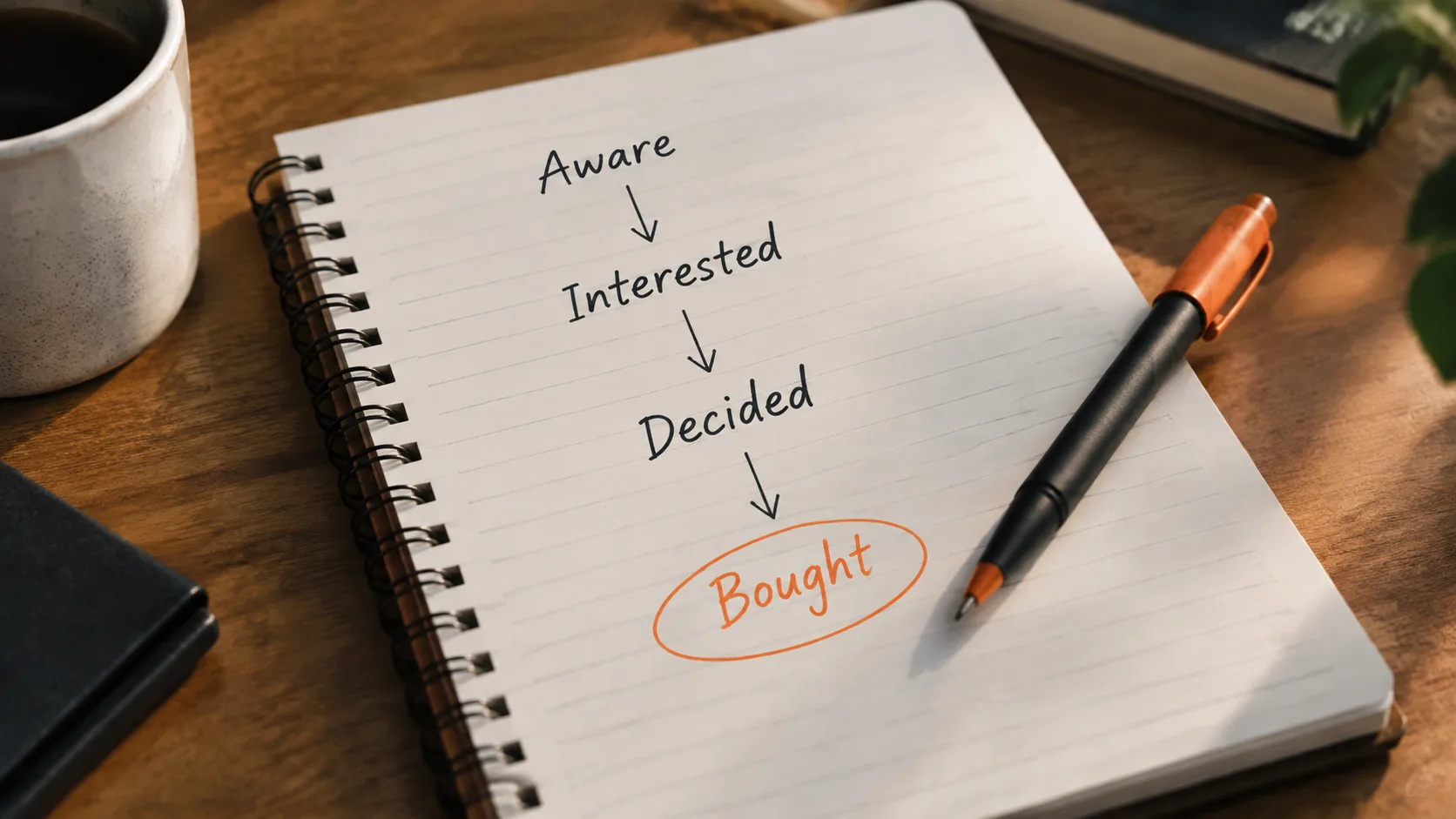
Different models use different labels, but the progression is the same: cold stranger to committed buyer. Here are the four stages you’ll see most often.
Top of funnel: Awareness
This is the widest part. Prospects find you through a blog post, a social clip, a paid ad, or a search result. They didn’t know you existed five minutes ago. The job at this stage isn’t to sell… it’s to earn a click and a second of attention. Different traffic sources each feed the top of the funnel differently, so pick the one you can actually stick with.
Middle of funnel: Interest and Decision
Now they’re paying attention. They read a second article, join your email list, register for a webinar, maybe download a checklist. This is where trust gets built… slowly, one useful email at a time. It’s also where they start comparing you to alternatives, weighing pricing, and asking, “Does this actually solve my problem?” Getting good at building authority with email marketing is what separates funnels that convert from funnels that leak.
Bottom of funnel: Action and conversion
They buy. They book the call. They upgrade. The action stage is the payoff, and a well-designed funnel removes friction here, no confusing checkout, no surprise fees, no “wait, which button do I click?” moments. Salesforce points out that some folks use the AIDA model (Awareness, Interest, Desire, Action), others use a flywheel (Attract, Engage, Delight), but the underlying journey holds. If you want to turn that first conversion into a repeatable habit, the first affiliate commission playbook is the closest thing to a step-by-step at this stage.
Takeaway: Four stages, one direction. Awareness fills the top, interest and decision warm people up in the middle, action closes at the bottom.
Why Sales Funnels Matter for Online Marketers and Affiliates

If you’re an affiliate marketer, a course creator, or anyone selling online, this is the section that matters most.
Funnels replace the scattergun approach
Without a funnel, most marketers spray traffic everywhere and pray. Facebook one week, TikTok the next, an abandoned blog somewhere in between. It feels like activity, but it isn’t a system. A defined funnel tells you exactly which touchpoint turned a browser into a buyer, so you can pour more fuel on what’s already working and quietly kill what isn’t. That kind of clarity is why so many people who get serious about training suddenly start seeing consistent commissions.
How funnels increase commissions and sales
Here’s the sneaky-good part. Most people who visit your page today are not ready to buy today. Without a funnel, you lose them forever. With a funnel, you capture the email, keep the conversation going, and stay in front of them until the timing is right. Then you stack offers, upsells, cross-sells, and follow-up sequences that quietly double or triple revenue per lead. Salesforce puts it well: sellers who understand the funnel build trust at each stage instead of pushing for the close before the prospect is ready, which protects the long game. If your goal is passive income online, a funnel is the thing doing the work while you sleep.
Takeaway: No funnel = scattergun. A funnel turns one-time visitors into repeat buyers and multiplies what every lead is actually worth to you.
How a Sales Funnel Actually Works: A Simple Example
Enough theory. Let’s walk one.
A real-world funnel walkthrough
A basic e-commerce funnel looks like this:
- Someone sees a social ad for a pair of running shoes.
- They click through and browse a few product pages.
- A popup offers 10% off in exchange for their email.
- They opt in, get a five-email nurture sequence with sizing tips and reviews.
- Email four contains a coupon code. They buy.
That’s it. Five steps, one purchase, one new customer to remarket to later. For a higher-ticket offer, coaching, software, a course, the funnel gets longer: lead magnet, email sequence, webinar, sales call, follow-up. Sometimes it spans months. Either way, the mechanics are the same, and pairing a funnel with automation from the start is what keeps it running without you babysitting every step.
Where most funnels break down (and how to fix it)
Salesforce’s team describes broken funnels perfectly: prospects fall out “like water flowing through a sieve.” The gaps are usually predictable:
- A weak opt-in offer that nobody actually wants.
- No email follow-up after sign-up, so the lead goes cold in 48 hours.
- No clear call to action at the decision stage, so interested buyers hesitate and leave.
Fixing gaps starts with tracking. You need to know your drop-off rate at every stage. When you can see 70% of people bail on your checkout page, you know where to focus. When you see 5% of email subscribers open your sequence, you know your subject lines are the problem. Consistent traffic generation means nothing if the funnel behind it leaks at every seam.
Takeaway: Funnels break at the gaps between stages. Track drop-off, plug the leak closest to the money first, then work upstream.
How to Build Your First Sales Funnel

Ready to stop reading and start building? Here’s the shortest honest path.
Step 1: Define your audience and offer
Who are you helping, and what one action do you want them to take? “I want more traffic” is not an offer. “I want beginner affiliate marketers to download my email swipe file” is. Vague goals produce vague funnels. Picking the right niche is the single decision that makes every later step easier.
Step 2: Choose your traffic source
Pick one. Organic search, paid ads, YouTube, TikTok, whatever fits your budget and personality. Trying to master all of them at once is how beginners burn out in month two. Get one channel producing leads consistently before you add a second. If you’re stuck on which to try, browse the tag/traffic-sources archive for real approaches that work for solo marketers.
Step 3: Build the funnel stages
Every functional funnel needs the same four pieces at a minimum:
- A landing page with one goal.
- A compelling opt-in offer (the lead magnet).
- An email nurture sequence that builds trust and pitches the offer.
- A clear conversion step, checkout page, booking link, whatever the “yes” looks like.
Test one variable at a time, headlines, opt-in offers, subject lines, and let the data tell you what’s working. Automation tools like funnel builders and CRMs handle the nurture side so leads stay warm without you manually sending anything. If you’ve never built the email side, the email list building starter guide is the shortest path to a working list.
Takeaway: Audience, one traffic source, four funnel pieces. Ship it ugly, then improve with data.
Conclusion: Your Funnel Is Already Running, the Question Is Whether It’s Working
Here’s the thing nobody tells beginners: you already have a funnel. Every business does. It just might be an invisible, unoptimized, leaky one that’s quietly costing you customers. Naming each stage and measuring the drop-off is the first real step to improving it, because you can’t fix what you can’t see.
The goal isn’t a perfect funnel on day one. It’s a funnel that gets 5% better every month, one test, one tweak, one plugged leak at a time. Twelve months of that compounding and your affiliate income looks very different. If you want more plain-English breakdowns like this one, head over to the blog at Jeff Aman for a good next stop. Now go map your funnel… even if it’s on the back of a napkin.
Frequently Asked Questions
What is a sales funnel in simple terms?
A sales funnel is the path someone takes from first discovering you to buying from you. It’s called a funnel because many people enter at the top, but only a smaller group makes it all the way through to the purchase.
What are the stages of a sales funnel?
Most funnels have four core stages: Awareness (they discover you), Interest (they engage), Decision (they evaluate), and Action (they buy). Some models use different labels like AIDA or the flywheel, but the progression from cold prospect to committed customer stays the same.
What is the difference between a sales funnel and a marketing funnel?
Marketing funnels focus on brand awareness and generating leads, getting eyeballs on your brand. Sales funnels pick up from there and focus on converting those leads into paying customers. The two overlap, but marketing fills the top and sales closes the bottom.
Why do I need a sales funnel for my online business?
Without a funnel, you’re relying on the scattergun approach: sending traffic everywhere and hoping something sticks. A funnel lets you capture leads who aren’t ready to buy today, nurture them, and convert them later, which dramatically increases revenue per visitor.
What is an example of a sales funnel?
A visitor clicks a social ad, browses your site, opts in for 10% off, receives a five-email nurture sequence, and buys with a coupon code in email four. That’s a complete e-commerce funnel in five steps from stranger to customer.
How do I build a sales funnel from scratch?
Define your audience and one clear offer, pick a single traffic source, then build a landing page, a lead magnet, an email nurture sequence, and a conversion step. Test one variable at a time and improve based on drop-off data.
What is the difference between a sales funnel and a sales pipeline?
A sales pipeline tracks the seller’s perspective: which deals are where in the process. A sales funnel is buyer-centric, mapping the questions and decisions the prospect works through. Same journey, different point of view.
How do I know if my sales funnel is working?
Track drop-off rates at each stage. If opt-in rates are healthy but email-to-sale conversion is weak, your nurture sequence needs work. If traffic is high but nobody opts in, your lead magnet is the problem. Data tells you where to focus.