Most affiliates dump links everywhere and wonder why commissions stay flat. A proper affiliate marketing funnel changes that… it guides real people from “never heard of this” to “take my money” in a predictable sequence. Jeff Aman covers exactly how to build that sequence, step by step, so your traffic finally earns what it should. Total build time: a weekend of focused work. Skill level: beginner-friendly.
What You’ll Need Before You Start

Before you touch a landing page builder, get the fundamentals lined up. Skip this and you’ll be optimizing button colors on a funnel that was doomed on day one.
Your niche and a matching affiliate offer
Choosing the wrong niche is the single most common reason affiliates see traffic but no sales. Niche picks come before offer picks, not after. Start with an audience whose problem you actually understand, then find the product. If you need a shortcut, these niche examples for affiliate marketing will save you weeks of second-guessing.
A good affiliate program checks four boxes: competitive commission rates, reliable tracking, clear terms, and (ideally) recurring or suite-based payouts so one customer earns you commissions repeatedly. Brand recognition matters too. When the buyer already trusts the product developer, your job shrinks from persuasion to confirmation. If you’re still figuring out how to vet programs, beginner-friendly training programs walk you through the vetting checklist.
The tools that hold the funnel together
Three tools cover 90% of what a beginner needs: a landing page or funnel builder, an email service provider, and a tracking solution. That’s it. You do not need seventeen SaaS subscriptions to start. If the tool stack still feels intimidating, the beginner-honest take on affiliate marketing difficulty sets realistic expectations before you swipe the credit card.
Takeaway: Lock the niche, pick one offer with recurring commissions, and get a three-tool stack live. Nothing else matters yet.
Step 1: Map the Funnel Stages Before You Build Anything

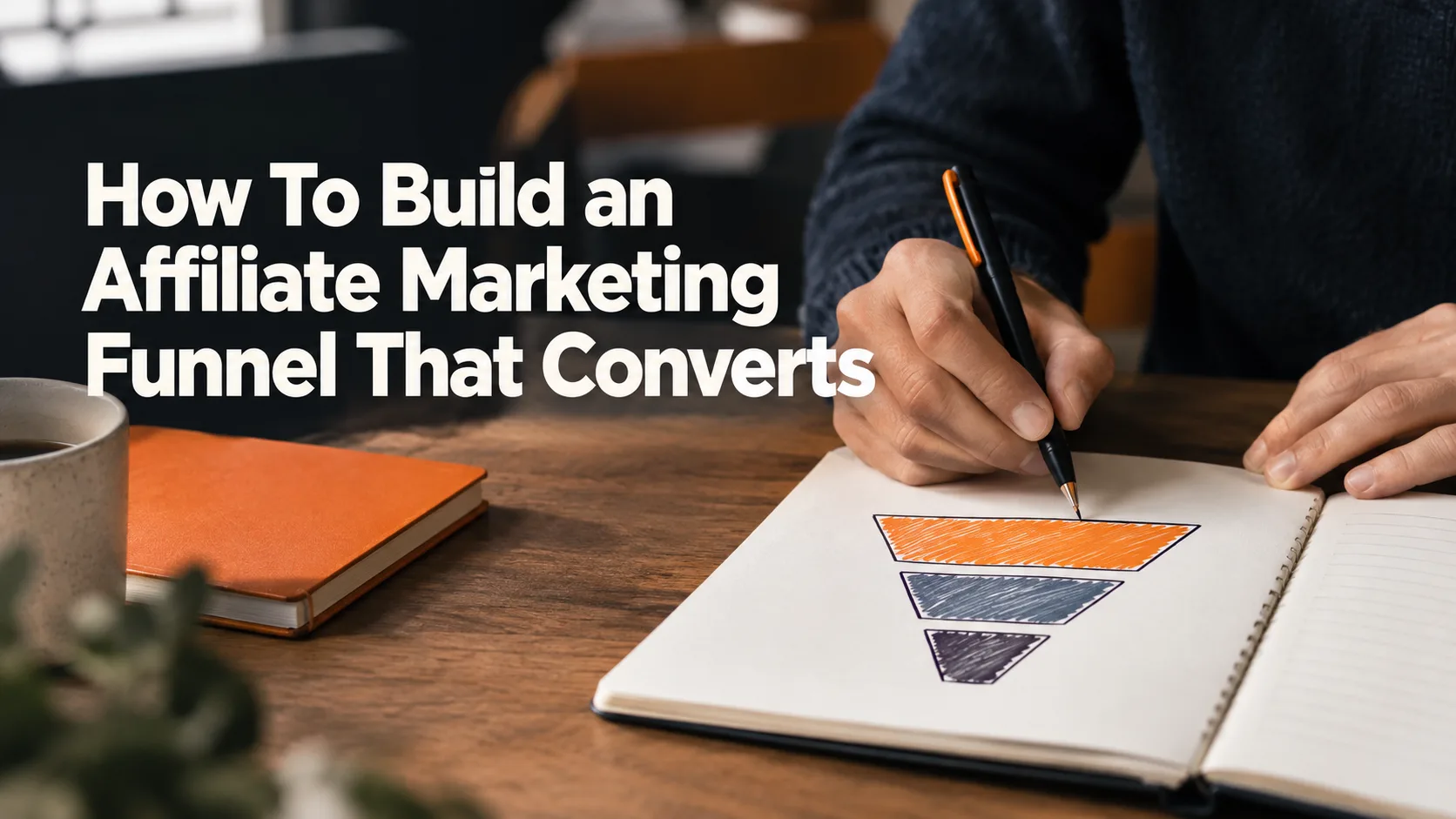
Affiliate funnels span three distinct stages: awareness, research, and conversion. Skip any one and you leave money on the table. Sketch this on paper first, then build. A quick primer on how a full sales funnel works helps if you’ve never mapped stages before.
Top of funnel: awareness and discovery
Top-of-funnel touchpoints introduce the brand in a trusted, organic context. Think SEO blog posts, gift guides, “best of” roundups, YouTube reviews, and short-form social. According to Rise’s full-funnel analysis, these placements drive discovery weeks before the actual purchase, which is exactly why “post link, wait for sale” fails so reliably.
Mid-funnel: engagement and trust
Mid-funnel content helps the reader validate their interest. Comparisons, “why I switched” angles, expert reviews, and honest weakness callouts do the heavy lifting here. This stage is where your product review hub shape earns its keep, because a reader in research mode wants specifics, not slogans.
Bottom of funnel: conversion
Bottom-of-funnel assets tip hesitant buyers over the line: deal pages, limited-time bonuses, targeted email sequences. Most affiliates already live here, often to the exclusion of the earlier stages, which is why their commissions stall. Fill in the earlier steps and the bottom-funnel work you’re already doing suddenly starts converting. Related reading: how to make your first affiliate commission with email marketing.
Takeaway: Sketch all three stages first. Then build assets for whichever one is missing.
Step 2: Build a Lead Capture Page That Actually Gets Opt-Ins

A bridge or squeeze page sits between your traffic source and the affiliate offer. It collects the email first, so you own the lead whether or not they buy on visit one. That single move is the difference between a business and a link-spraying hobby, and it’s the foundation of starting an email list from scratch.
What makes a landing page convert
Page load speed directly affects opt-in rates. Slow pages lose clicks before the visitor reads the headline. Convertri’s team notes that every extra second of load time hits both bounce rate and ROI, which matters double when you’re paying for traffic. Keep the page focused: one headline, one promise, one form, one button. If you want visual proof of what’s working, browse the digital marketing category for concrete examples.
Mobile optimization is non-negotiable. Most affiliate traffic arrives on phones, so if your form fields cram off the screen, you lose the majority of your audience. Test on your own phone before you spend a dollar on ads. For a broader view of the traffic side, the site traffic generation tag is worth a skim.
Crafting the lead magnet offer
An effective lead magnet solves one specific problem your target audience already knows they have. A three-page cheat sheet, a five-item checklist, or a six-minute video tutorial outperforms a vague “free newsletter” every time. Match the magnet to the funnel’s end offer so subscribers self-select. More on the philosophy behind this in how to earn passive income online.
Takeaway: One promise, one form, one focused freebie. Ship the ugly v1 today and improve later.
Step 3: Set Up an Email Sequence That Warms Leads to the Offer

An email sequence lets you follow up automatically with every lead captured, turning one traffic visit into six or seven touchpoints without extra ad spend. This is where affiliates go from sometimes lucky to consistently paid. If you want the deeper theory, using email marketing to build authority is worth an hour.
Structuring the follow-up sequence
A practical starter sequence looks like this:
- Email 1: Deliver the lead magnet. Nothing else.
- Emails 2-3: Related value + credibility building. Share a story or a quick win.
- Emails 4-5: Introduce the affiliate offer with context, not a cold pitch.
- Email 6+: Handle objections, add a soft deadline or a bonus.
Set it up once, then let it run while you focus on traffic. That’s the automation logic behind a self-running online business in a nutshell.
Balancing value emails with promotional emails
Mix education with promotion. A ratio of roughly two value emails per one promotional email is a common practitioner starting point; adjust based on how your list responds. Segment subscribers by behavior (clicks, opens, purchases) so you can send targeted follow-ups that match where each lead sits in the buying decision. For inspiration on tone and cadence, the email marketing tag collects the relevant reads.
Takeaway: Write six emails. Load them. Segment on clicks. That’s your minimum viable follow-up.
Step 4: Drive Targeted Traffic Into the Top of Your Funnel
You now have a funnel. Nobody’s in it. Time to fix that. Diversify across at least two traffic channels so a single platform change doesn’t wipe out your leads overnight. The traffic sources tag is a good jumping-off point.
Free traffic channels
SEO-driven blog content targeting category-level search terms drives consistent organic traffic to the awareness stage without ongoing ad spend. The catch: it takes months to compound. Start writing now, even if the first posts feel underwhelming. YouTube reviews and niche community participation (helpfully, not spammily) also count as free. See the blog archive for topic angles.
Paid traffic channels
Paid channels like search ads and social ads deliver volume quickly but demand fast pages and tight compliance with each platform’s affiliate policies. One rejected ad account can gut a campaign, so read the rules twice. Niche influencers can also serve as top-of-funnel affiliates themselves, introducing you to trusted audiences you’d otherwise take years to build. For the broader picture on channel diversification, see how to create a passive income online from scratch.
Takeaway: Pick one free channel and one paid channel. Ignore the rest until both are working.
Step 5: Track, Test, and Tune the Funnel
You cannot fix what you cannot see. Instrument the funnel from day one, then improve the weakest stage. Small changes compound quickly, which is a nice complement to the passive income mechanics you’re building here.
Metrics that actually matter
Watch three numbers, one per stage:
| Funnel stage | Metric | What “good” looks like |
|---|---|---|
| Landing page | Opt-in rate | 20%+ from warm traffic |
| Email sequence | Open + click-through | 25%+ opens, 3%+ CTR |
| Offer page | EPC / conversion rate | Program-specific benchmark |
Multitouch attribution, not last-click alone, reveals which traffic sources contribute earlier in the funnel. That intel guides smarter content investment. More on the wider affiliate marketing tag if you want context.
A/B testing your funnel pages
A/B testing headlines and calls to action on the opt-in page is often the highest-use improvement a beginner can make. Small copy changes routinely shift conversion rates in meaningful ways. Iterate one variable at a time. Change the headline, the lead magnet, and the button color at once and you’ll never know what actually moved the needle. If you want to go deeper on the whole online-business side of testing, starting from zero has more.
Takeaway: Track three numbers. Test one thing at a time. Kill what doesn’t work.
FAQ: Frequently Asked Questions
What is an affiliate marketing funnel and how does it work?
An affiliate marketing funnel is a staged path that moves a stranger from first exposure to a purchase through your affiliate link. It works by capturing the email, building trust with follow-ups, then presenting the offer with context.
Do I need a website to build an affiliate marketing funnel?
No, but you need a landing page. A hosted funnel builder or a single opt-in page is enough to start. A full site helps with SEO traffic later, but the funnel itself lives on one or two pages.
How long does it take to build a funnel that makes commissions?
A basic funnel can be live in a weekend. Real commissions depend on traffic. Expect 30 to 90 days of consistent driving traffic and tuning before the numbers look meaningful, longer if you’re relying solely on SEO.
What is a bridge page and why do affiliates use one?
A bridge page sits between your traffic source and the affiliate offer, capturing the email first. Affiliates use one because it turns a single click into a lead they own, letting them follow up long after that first visit.
Which funnel builder is best for affiliate marketing beginners?
The best builder for beginners is one with fast page speeds, drag-and-drop editing, honest pricing, and solid email integrations. Convertri, Systeme.io, and similar tools all fit that brief; pick whichever matches your budget.
How many emails should be in an affiliate follow-up sequence?
Start with six to eight emails: one delivery email, two to three value emails, two promotional emails with context, and one or two objection-and-deadline emails. Extend the sequence once you see which topics get the most engagement.
Can I build an affiliate funnel without paid traffic?
Yes. SEO blog posts, YouTube reviews, community participation, and organic social can all feed the top of your funnel. It just takes longer to compound. Most successful affiliates eventually mix free and paid to stay resilient.
What is the difference between a sales funnel and an affiliate funnel?
A standard sales funnel promotes a product you own. An affiliate funnel promotes someone else’s product for a commission. The mechanics are the same; the difference is that affiliates rarely control the offer page, so the pre-sell work matters more.
Wrapping Up
An affiliate marketing funnel is not complicated. It’s a landing page, an email sequence, a traffic plan, and the discipline to test one thing at a time. Build the ugly version this weekend, drive traffic on Monday, and tune based on what the numbers tell you. If you want a running set of tactics and honest breakdowns as you go, Jeff Aman’s blog is where the next steps live. Now go build.