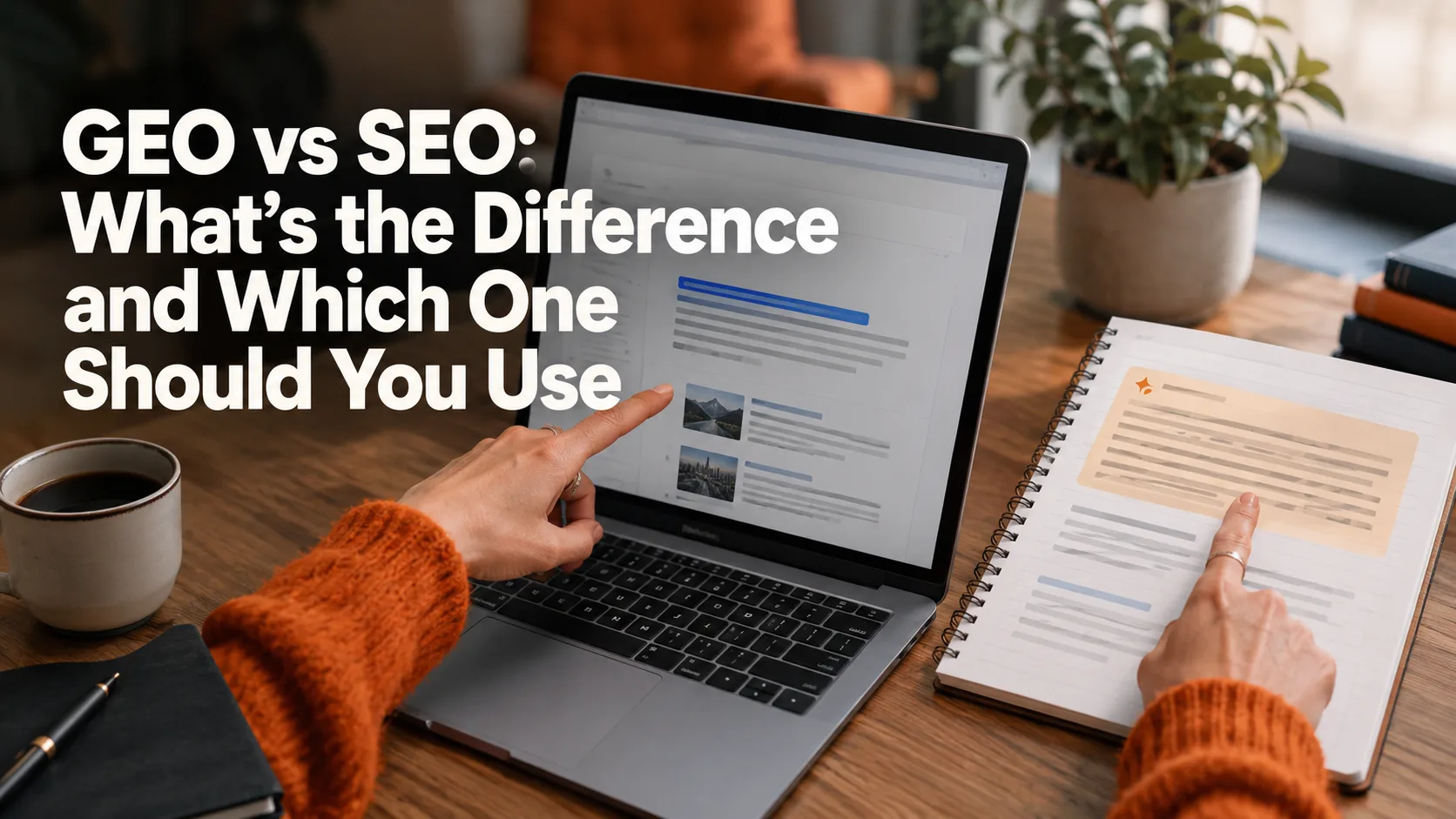
Search is splitting into two lanes right now… and most marketers are only driving in one of them. Jeff Aman’s marketing blog breaks down GEO vs SEO, what each one actually does, where they overlap, and which one deserves your attention first. If you’ve been hearing “generative engine optimization” everywhere and wondering if it’s just SEO with a new hat, keep reading. It’s not.
Quick Verdict: GEO vs SEO at a Glance
Short version? SEO is still the stronger horse if you want measurable organic traffic and click-through revenue. GEO wins when the goal is brand visibility inside an AI answer where the user never clicks a link at all. Different jobs, different scoreboards. If you’re running an affiliate site built on organic clicks, SEO pays the bills today.
Here’s the cleanest way to think about it. SEO targets Google’s ranked list of blue links. GEO targets the synthesized recommendation an AI tool like ChatGPT or Perplexity gives instead of a list. One puts you on a shelf; the other gets the shopkeeper to point at you. Both matter, but the timing and the traffic sources you rely on should decide which one you obsess over first.
And this is not hypothetical anymore. According to a Bain-Dynata Generative AI Consumer Survey cited by Informa TechTarget, 80% of consumers now rely on AI-written results for at least 40% of their searches, cutting organic web traffic by 15% to 25%. That’s a real dent in the funnel, and it’s why even hardcore SEO-first marketers building online businesses are paying attention.
The good news: both disciplines reward the same underlying thing. High-quality, well-structured, authoritative content. So strong SEO is the foundation you build GEO on top of. Not two workflows. One workflow, two payoffs. The beginner’s guide to generating passive income online makes exactly this point: build the content once, let it work across multiple channels.
At a Glance: GEO vs SEO Compared
| Feature | SEO | GEO | Winner |
|---|---|---|---|
| Pricing / cost model | Free organic + tool costs | Free organic + tool costs | Tie |
| Core mechanism | Crawler indexing + ranking signals | LLM synthesis + citation | SEO (mature) |
| Ease of tracking | Rankings, CTR, traffic | Citation frequency, brand mentions | SEO |
| Target user | Click-through / conversion sites | Brand awareness, high-consideration | Depends |
| Integrations | Analytics, Search Console, Semrush | Emerging tools, manual audits | SEO |
| Support / documentation | Decades of playbooks | 12-18 months of guidance | SEO |
| Free tier / entry | Yes, DIY friendly | Yes, DIY friendly | GEO (lower barrier) |
How the underlying technology differs
SEO runs on crawlers and hundreds of ranking signals: keywords, backlinks, site speed, mobile friendliness, structured data. It is largely deterministic. Same query today, roughly the same ranked list tomorrow. That predictability is why the beginner affiliate marketing playbooks still lean so heavily on SEO fundamentals.
GEO runs on large language models built on transformer architecture. Instead of matching keywords, LLMs interpret intent and generate a synthesized answer on the spot. The output is non-deterministic. Ask twice, get two slightly different replies… which makes the game feel closer to reputation building than ranking hacking, and closer to the authority-building work email marketers already do.
What success looks like for each
SEO success is measured in ranked positions, CTR, and organic traffic volume. GEO success is measured in citation frequency inside AI answers. According to Semrush’s March 2025 study of 10 million-plus keywords, 13.14% of all queries triggered Google AI Overviews, up from 6.49% in January 2025. That doubled in three months. Whichever side of the traffic equation you’re on, that’s a number worth watching.
Forrester’s John Werner puts the stakes bluntly: if your business isn’t appearing in AI-generated answers, potential customers may never discover you, even if you rank well in traditional search. That’s the GEO argument in one sentence.
How SEO Works and Who It’s For

SEO is the old warhorse. It works. It’s been working. And for anyone monetizing traffic through commissions, ads, or lead gen, it is still the most direct route to revenue. If your income depends on getting a human from a search results page to your landing page, you cannot skip this step. Full stop. It’s why passive income playbooks for beginners still start with SEO.
Core SEO tactics that still move the needle
The list hasn’t changed much, honestly:
- Keyword research anchored to buyer intent
- On-page optimization: headings, meta descriptions, alt text, internal links
- Clean site architecture and XML sitemaps
- Structured data / schema markup
- Quality backlink acquisition
- Fast, mobile-friendly pages
SEO content is built to rank and drive clicks. The goal is getting a user from the SERP to your site, where the conversions actually happen. If you’re picking your first vertical, the niche selection process for affiliate marketing is where SEO planning starts.
Where SEO falls short today
Zero-click search. That’s the shorthand. When a user asks Google a question and gets a complete AI-generated answer at the top of the page, they don’t need to click anything. Your ranking is technically fine. Your traffic just… isn’t there. That’s the crack that GEO tries to fill, and it’s why beginners wondering whether affiliate marketing is hard are hearing new terminology every month.
Takeaway: SEO is not dead. It’s just no longer the whole board.
How GEO Works and Who It’s For

GEO is about getting recommended, not just listed. When an AI tool names your brand or product inside its synthesized answer, that’s the win. Think of it as word-of-mouth referral at machine speed. The broader digital marketing playbook is quietly rewriting itself around this idea.
Core GEO tactics: writing for AI citation
Per Semrush’s GEO vs SEO guide, optimization for generative engines means:
- Writing in natural question-and-answer format
- Using factual, precise language (LLMs distrust fluff)
- Structuring content so models can parse and summarize it
- Avoiding JavaScript for anything that matters
- Earning mentions on other trusted, authoritative sources
- Adding schema markup wherever it fits
Bain & Company also recommends diversifying content formats. Video, interactive tools, comparison tables. The content strategy featured across most modern blogs is trending in that direction anyway.
Who benefits most from GEO right now
High-consideration categories. Software, finance, health, retail. Anywhere AI tools are already fielding buying-intent questions. If you’re in one of those spaces, GEO is a brand-awareness and trust play that compounds. If you’re an affiliate marketer in a broader niche, GEO is still worth doing but ranks below your email list-building work and core SEO in priority order.
Takeaway: GEO builds recognition. It rarely builds a click today.
Where GEO and SEO Actually Overlap

Here’s the honest bit: most of what makes content GEO-friendly also makes it SEO-friendly. Topical authority. Clear headings. Answered questions. Original data. Structured formatting. That’s the whole game on both sides, which is why building a real online business from scratch doesn’t require picking one lane.
Shared foundations both strategies build on
Both channels reward:
- Topical authority (publish clusters of related content in one domain)
- Direct, conversational answers to real questions
- Original research, unique data, and proprietary examples
- Proper headings, bullet points, FAQ blocks, schema
- Verifiable citations to trusted sources
That last one is bigger than it sounds. LLMs weigh source reputation heavily, and Google’s ranking system does the same. So the tag ecosystem around passive income content that already works for SEO is also feeding GEO.
How to optimize one piece of content for both
Audit each piece for two things: narrative depth (does it read smoothly for a human conversation?) and technical readiness (is it crawlable, keyword-aligned, and schema-marked?). That’s the practical takeaway from both Semrush and Informa TechTarget. Content that hits both is the sweet spot, and it’s the format most passive income guides for beginners are quietly moving toward.
Takeaway: stop treating them as separate workflows. One audit, two payoffs.
Where GEO Still Loses to SEO
Now the honest part most GEO evangelists skip. If you’re an affiliate marketer, GEO has real limitations right now.
Tracking is a mess. Most analytics platforms don’t reliably capture AI referral traffic. You can be cited a hundred times and see nothing in GA4. Attribution is guesswork, and ROI conversations get awkward fast. Even the passive income route starting from zero is easier to measure than GEO citation frequency.
There’s no equivalent of a stable ranking position. Your content can be cited today and vanish tomorrow with no transparent reason. There’s no Search Console for LLMs. No rank tracker that means much. And for anyone whose revenue depends on page visits and on-site conversions, that ambiguity is expensive. SEO remains the more direct, measurable growth lever, which is why most reviews of monetization tools still weigh organic click volume above brand mentions.
Who Should Pick Which

Pick SEO first if…
- You’re building an affiliate site or monetizing through commissions
- You need predictable, measurable content ROI
- Your revenue model requires clicks and on-site conversions
- You’re solo or a small team with limited hours
Start here. SEO’s click-based model still works, and GEO builds on top of it. The first-commission playbook using email marketing assumes SEO traffic is doing the heavy lifting on top of the funnel.
Add GEO when…
- You already have a decent content foundation
- You want to reformat existing posts in Q&A style
- You can add verified statistics with citations
- You want brand mentions in AI answers at buying moments
SEO brings people in. GEO helps you show up at the exact moment someone is ready to decide. Different stages of the buyer journey inside a proper B2B sales funnel, essentially. A rough 70/30 split (SEO fundamentals to GEO-specific formatting) is a fair starting point for most solo marketers.
Takeaway: SEO first, GEO layered on. Don’t skip the foundation to chase the trend.
Frequently Asked Questions
What is the main difference between GEO and SEO?
SEO optimizes your site to rank in Google’s list of results. GEO optimizes your site so AI tools like ChatGPT or Perplexity mention or cite you inside a synthesized answer. Different targets, similar foundations.
Do I need to do both GEO and SEO?
For most content-driven businesses, yes. SEO still drives measurable clicks and commissions. GEO builds brand visibility inside AI answers where clicks may never happen. Doing both hedges against zero-click search and keeps you visible everywhere.
Does GEO replace SEO?
No. GEO complements SEO. AI tools still pull from indexed, high-authority web content, so strong SEO fundamentals actually improve your GEO citation odds. Treat GEO as a layer on top of solid SEO, not a replacement for it.
How do I optimize my content for GEO?
Write in question-and-answer format, use factual and concise language, add schema markup, structure content with clear headings, and avoid JavaScript for key details. Original data and citations from trusted sources also improve your chances of being quoted.
How is GEO success measured if there are no clicks?
Citation frequency inside AI answers is the main metric. Track brand mentions across ChatGPT, Perplexity, Google AI Overviews, and Copilot manually or with emerging monitoring tools. It’s less precise than SEO analytics, so treat it as a brand-awareness signal rather than a direct revenue metric.
Which AI tools does GEO target?
GEO targets generative AI search tools including ChatGPT, Google AI Overviews, Perplexity, Microsoft Copilot, and Google Gemini. These systems synthesize answers instead of returning ranked lists, so getting cited inside their responses is the goal of any GEO strategy.
Is GEO relevant for affiliate marketers?
Somewhat, but SEO still comes first. Affiliate revenue depends on clicks to landing pages, and GEO citations rarely produce those. That said, brand mentions in AI answers can build trust that improves your click-through rates later, so it’s worth layering in.
How fast is AI search growing compared to traditional search?
Very fast. Semrush found that Google AI Overviews jumped from 6.49% to 13.14% of queries between January and March 2025, doubling in three months. Bain-Dynata reports 80% of consumers now rely on AI-written results for at least 40% of searches.
The Bottom Line
If you take one thing away: build SEO first, layer GEO on top, and don’t panic. The fundamentals haven’t changed as much as the headlines suggest. Quality content, structured well, that answers real questions from real people… still wins on both scoreboards. The affiliate marketing resources at jeffaman.com are built on that same assumption, and it’s the same advice that will hold up whether the next search interface is a list, a chat, or something we haven’t seen yet. Go get some clicks. Then go get some citations.